Thursday, March 22, 2007


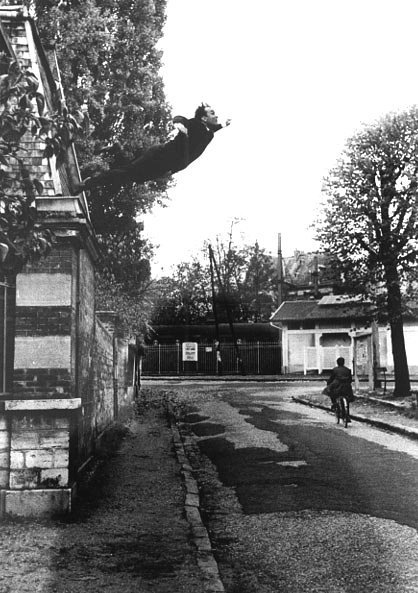
Yves Klein's "Le Seut dans le Vide" (1960). In the 1950s, France was beset by various New Waves as part of a general youth movement. Born in 1928, Yves Klein belonged to the Nouveaux Réalistes, a group of emerging young French artists. Klein’s staged leap from the second story window of his dealer Colette Allendy’s apartment in Paris inspired numerous artists to explore the body’s limits.

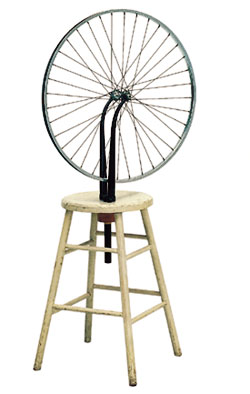
Marcel Duchamp's "Bicycle Wheel" (1913). "The Bicycle Wheel is my first Readymade, so much so that at first it wasn't even called a Readymade. It still had little to do with the idea of the Readymade. Rather it had more to do with the idea of chance. In a way, it was simply letting things go by themselves and having a sort of created atmosphere in a studio, an apartment where you live. Probably, to help your ideas come out of your head. To set the wheel turning was very soothing, very comforting, a sort of opening of avenues on other things than material life of every day. I liked the idea of having a bicycle wheel in my studio. I enjoyed looking at it, just as I enjoyed looking at the flames dancing in a fireplace. It was like having a fireplace in my studio, the movement of the wheel reminded me of the movement of flames."-- Marcel Duchamp, A Propos of Readymades (1951)

Egypt's Pyramids (5000 B.C.) could be seen as a series of conceptual pieces (installations in the dessert?). In his Introduction to Aesthetics, G. F. Hegel compares the pyramids to the beginning of the development of the “Idea.” (For some, “All triangles have three sides” is an a priori proposition). In his 1972 “Art History,” John Baldessari uses a similar photo to imply the same idea.

Friday, March 9, 2007

A propos of Female art

The show Wack! Art and the Feminist Revolution at MoMA has something to do with our conversation about female art last night. This article (in The NYTimes adds): "Feminist art, which emerged in the 1960s with the women’s movement, is the formative art of the last four decades. Scan the most innovative work, by both men and women, done during that time, and you’ll find feminism’s activist, expansionist, pluralistic trace. Without it identity-based art, crafts-derived art, performance art and much political art would not exist in the form it does, if it existed at all. Much of what we call postmodern art has feminist art at its source."

Thursday, March 8, 2007

Contemporary female art

First, we would have to make a distinction between female art and Feminist art. Whereas the first is a label for art made by women, the latter addresses very specific socio-political issues regarding the exploitation of women by men. Feminism is right about the suppression and dislocation of women from the public sphere (since the Renaissance until the end of the Twentieth Century; just look at the disproportion of male and female artists in Modern art history). 1- An important alert to feminist issues came in the 1970’s, with artist Judy Chicago’s The Dinner Party, a work that used several traditionally “feminine” art-mediums to teach women’s history (Chicago’s work represents the ways in which feminists began to explore their oppression through art). Why is it that the early avant-garde (Impressionism, Post-Impressionism, Fauvism, Expressionism, Futurism, De Stijl, etc) were essentially male-driven movements? I don’t want to dwell in the causes of this phenomenon, which has been well-documented by Simone De Beauvoir's The Second Sex, Shulamith Firestone’s The Dialectics of Sex and Carol Gilligan’s In a Different Voice (among many others). 2- Since the 1960’s female art has brought forth a new attention to materials: ceramics, latex, rubber, fiberglass and yarn. There is a return to fiber media: weaving, quilt-making, etc. Formally, female art is generally characterized by a biomorphic, more fluid focus. In performance/art, video and photography, women have explored gestures of objectification and exploitation from a different perspective than those found in male performances (which tend to be more heroic). 3- Although art is universal, the claim that art is genderless is not true (See post-feminism). Can you think of any particular female art themes? Go ahead.

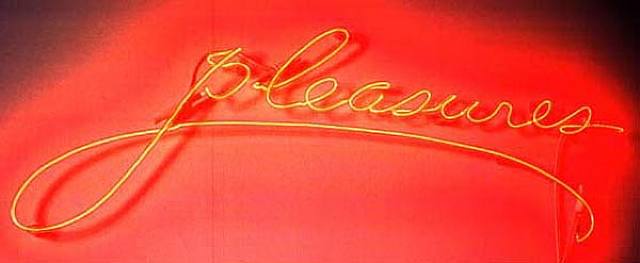
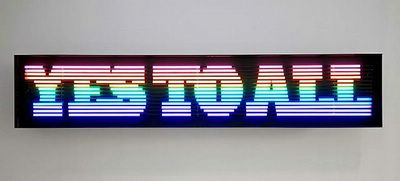
Sylvie Fleury's "YES TO ALL" and "Pleasure" (2000's). Fleury displays stylish items of fashion and design in order to compare and clash them with the everyday world. In a way, fashion is dissected from its aura and made banal.


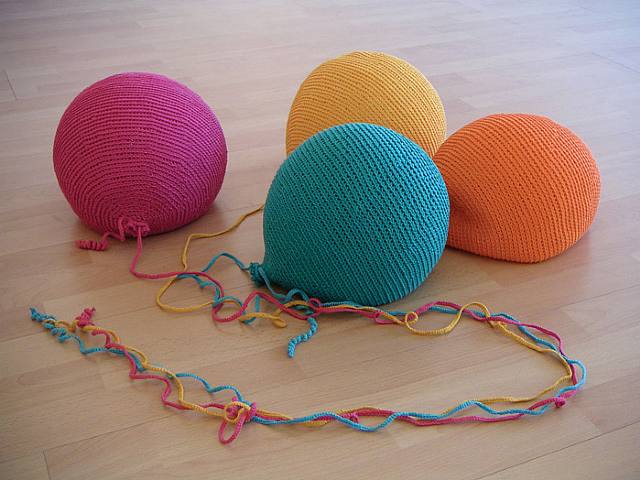
Frances Trombly's "Four Balloons" and "Paper Stack" (2005). "Frances Trombly's current show It Makes Me Happy, comprised of intricate representations of the mundane objects on the periphery of celebration, focuses on the act of gift giving. Trombly infuses the ordinarily mass-produced items with value by knitting or weaving the recreations in order to remind the viewer of the thoughtfulness that should symbolize gift giving. In transferring the emphasis from the gift to the human contact, Trombly nudges us away from the powers of the consumer society to a more emotional approach to celebration."-- Mocoloco.com

Sarah Lucas' "Aunty Jam" (1990's). Lucas often employs metaphors that symbolise sexual body parts. These metaphors are frequently food or furniture which she utilises as ready-mades, attributing new meanings to them. "The message of these works is clearly autobiographical. Lucas's breast-chair has predictable things to say about the role of domestic woman as apiece of furniture, a thing to be sat on; by covering the chair in a layer of cigarettes, the artist presumably means to explain the link between the eternal drudgery of women and their desire to kill themselves slowly with fags. Her life vest, which doubles as a pair of breasts, says much the same kind of thing about the effect on women as sexualised objects. Given the artist's pungent frame of reference, it is probably not going too far to suggest that the covert message of Lucas: life sucks."-- Charles Darwent, The New Statesman (2000).

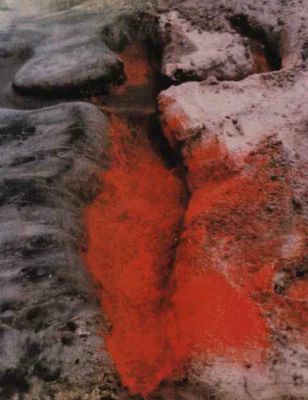
Ana Mendieta's "Silueta" (1970's). Ana Mendieta envisioned the female body as a primal source of life and sexuality, as a symbol of the ancient paleolithic goddesses. In her siluetas, Mendieta used her body or images of her body in combination with natural materials. "Mendieta was both of her time and, more importantly, beyond her time. Although the styles she embraced could be labeled performance art, body art and earthworks, she was an artist who defied stereotyping and whose obsession with overturning new ground brought forth an aesthetic force of infinite magnitude. "--Heidi Rauch & Federico Suro, Americas Magazine, October 1992.


Valie Export's "Made in Austria" and "Action Pants: Genital Panic" (1970's). Austrian artist Valie Export has worked in film, video, photography, text and performance. Initially expanding the Viennese Actionist project to confront a complex Feminist critique of the social and political body, her works achieve a compelling fusion of the visceral and the conceptual. As Valie Export contends, society has defined femininity in terms of a grammar of body - lips, breasts, legs - parts that are so interchangeable and genetic that woman herself become interchangeable and in this sense no longer exit.


Pipilotti Rist's "Fourth Wall" (2000's). "Having fantasised as a teenager that she was the Swiss John Lennon, Rist played drums, flute and bass for several years in the band Les Reines Prochaines and she has long been fascinated by the power and potential of pop. Her video soundtracks are often familiar-unfamiliar renditions of classic pop ballads with a raw bass guitar edge, devoid of pop promo gloss. Many of her songs are written with Anders Guggisberg, and they often collapse into hysterical disintegration by the end, quickly dispelling any candy-pop fantasies of easy gratification. In the past, Rist's installations have explored the signifiers of femininity and co-opted them into a new political aesthetic that critically celebrates femininity without attacking masculinity. A startling reworking of 1970s feminist political film, video and performance, as well as the sexual cliché of contemporary 'porno-pop', Rist's work is close to the celebratory, no-hostage wit of artists like Sarah Lucas. Rist's flow of imagery seduces and unnerves, exploring mutability, transformation and visual pleasure experienced through all the senses. Her installations present ideas that offer a space to think - or rather, to un-think our assumptions and perceptions."-- Taken from http://www.padt.org.uk/


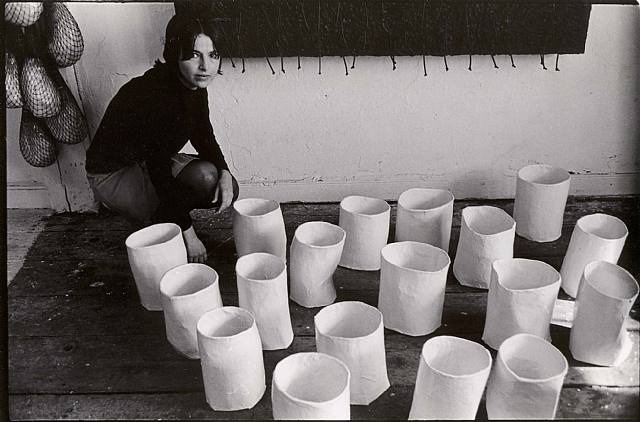
Eva Hesse's "Nets" (1960's). Hesse was sent with her sister to Holland to flee the Nazis in 1938. Their parents joined them and they moved to New York in 1939. When Eva was nine, her parents separated and her father remarried. A few months later her mother, who had a history of depression, committed suicide by throwing herself from a window. Hesse used to say that she aimed to create ‘nothings’. One can create a ‘nothing’ by making things that aren’t things (in the sense fixed representative objects). And Hesse’s objects always do more than merely represent. If art is always made to mean things and to represent, the only way out is to make what Hesse called "non-art."

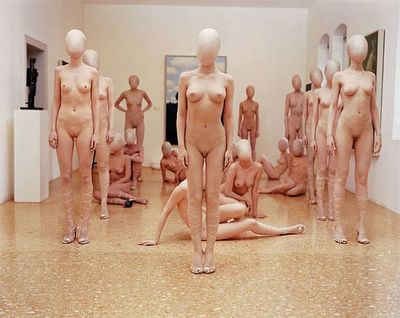
Vanessa Beecroft's "Untitled" (2000's). Beecroft has become famous for her human installations featuring armies of vaguely similar women (and lately men) wearing identical underwear, high heels, wigs, and not much else. Their nudity becomes almost like a uniform. She explores the intrusion of the public, Pop, fashion, conceptual art, and the body as object. "Beecroft delves into culture's maelstrom, searching for female types found throughout the history of art, cinema, and the theater, and whose characteristics she has largely assimilated. Directing and changing the bodies of others, she tries to reconcile the representation of ideal womanhood with the physical and psychological experience of her own body. Beecroft exploits the processes of perception and identification, often dissolving genders and mixing genres, in order to pinpoint the conflict between image and self-image in a way both provocative and healing."-- Elizabeth Janus, Art Forum International, May 1995.

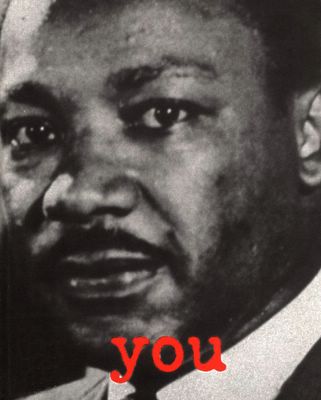
Adrian Piper's "You" (1990's). Piper is a conceptual artist (and philosophy professor) whose work, in a variety of media, has focused on racism, racial stereotyping and xenophobia. "I recall the New Museum's experience hosting the Adrian Piper retrospective a couple of years ago: Having thought of Piper as a bit of a cult figure, we were unprepared for the hoards of twenty-somethings who, filling our galleries, seemed entirely comfortable with what they were experiencing. At the time, I reflected that most art skips a generation before finding its audience and that a generation raised on the Internet no longer questions the precepts of Conceptual art. This generation, facing a previously unimagined set of challenges, assumptions, and possibilities, can now experience Feminism as something its founders never could: a historical continuity, flowing from one generation to the next, always adaptable to the needs anti strengths of a new wave of the curious and the bold."-- Dan Cameron, Art Forum International, October 2003.


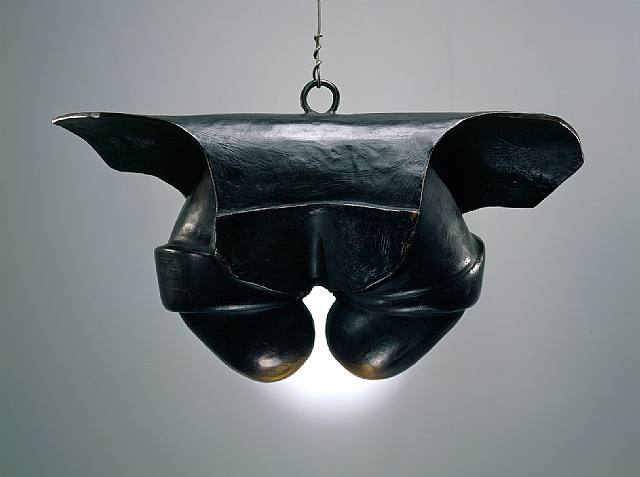
Louise Bourgeois' "Untitled" and "Hanging Janus with Jacket" (1960-80's). Bourgeois' sculptures exhale the sweat of erotic work. They may not be immediate figures of desire, but they position themselves clearly as “operations” where desire becomes manifest. "Rising like a proud, pristine phoenix in a Pasolini opera from the ashes of th past, overcoming obstacles as mighty as deconstruction and as petty as simulation, Bourgeois reigns supreme, and her subjects do not (and cannot) hide their worship, for her stamp is all over their works as brazenly as so often their politics are written on their black crepe Comme des Garcons sleeves."-- Christian Leigh, The Earrings of Madame B.

Rosemarie Trockel's "Untitled" (2000's). Trockel is one of the most important figures in the contemporary art movement in Germany. Trockel challenges established theories about sexuality, culture, and artistic production. "First encounters with Rosemarie Trockel have often left American viewers puzzled. The many narrative routes into her work, plus the specificity of her German-language references, can appear unfathomable. Yet this didn't prevent a favorable critical consensus from emerging here in the 1990s. Indeed, the very notion of missed signals is at the heart of her practice, as demonstrated by a sub-installation in her latest appearance in New York. "--Gregory Williams, Art Forum International, February 2003.


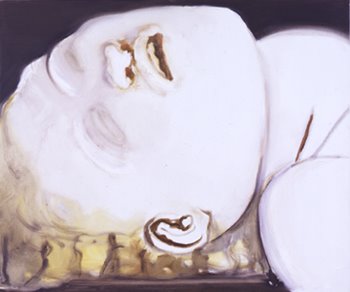
Marlene Dumas' "Euro" and "Lucy" (2000's). Racism, sexuality, religion, motherhood and childhood are all presented with chilling honesty in Dumas' paintings. "Dumas's obsessive return to the human face and figure make her a sort of anti-Richter. She understands that to the model, the camera's indifference is no more absolute than a psychoanalyst's silence is to the patient: Both are flagrant invitations to the melodrama of transference. And we are all models, sooner or later. Or as Dumas describes our yearning relationship with the mechanical eye in the title of a 1997 painting, a group portrait of eight haughty demoiselles stripped down to their frilly white underwear, We Were All in Love with the Cyclops."-- Barry Schwabsky, Art Forum International, January 2000.

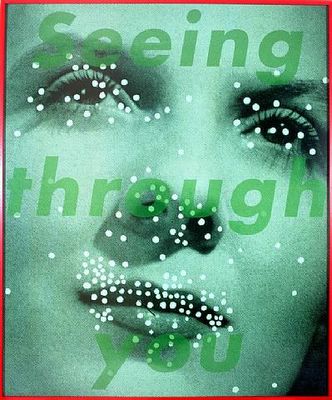
Barbara Kruger's "Seeing Through You" (1980's). Kruger really knows how to capture our attention with her bold socio-political photomurals, displayed on billboards, bus stops and public transportation as well as in major museums and galleries wordwide. "Kruger herself has explained her work in terms of critique, one that finds its ally in words and its target in pictures; her aim, she says, is to "interrupt the stunned silences of the image with the uncouth impertinences and uncool embarrassments of language." The idea that visual imagery is inherently pernicious is played up not only by the bygone McCarthy-era look of most of her black-and-white photos, but also by their often violent subject matter, a violence aestheticized through noir lighting or other abstracting effects."--Lane Relyea, Art Forum International, February 2000.

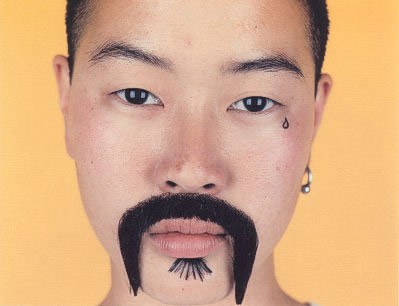
Catherine Opie's "Portrait" (2000's). Catherine Opie gained national attention for her large format portraits of dyke daddies, gay male performance transvestites, FTM transexuals, tattooed and scarified gay men and lesbians and other members of a social milieu where sexual identity is most dramatically thrown into question. Opie places her subjects clearly and calmly in the center of focus.

Barbara Hepworth's "Oval" (1950's). British Hepworth’s adherence to abstraction was lifelong and drew on geometric as well as organic shapes. She introduced into England the idea of piercing the solid mass of sculpture with a "hole," making the object more transparent. This concept influenced the future work of Henry Moore, among others. Hepworth’s hollow interiors become more important than the enveloping material. As the viewer's eye is drawn inside the sculpture, the openings invite the surrounding landscape to become part of the artwork.

Nan Goldin's "Untitled" (1990's). Goldin is an example of an artist who works at the most intimate level: her life is her work and viceversa. Her "snapshot"-esque images of her friends --drag queens, drug addicts, lovers and family-- are intense, searing portraits which, together make a document of Goldin's life.

Wednesday, March 7, 2007

Liz Cerejido

Tomorrow Liz Cerejido, the curator at FIU will come to talk to the class. It should be fun.

Friday, March 2, 2007

Tao Rey

Just talked to Tao: He couldn't make it to class because he had a flat tire. He feels very badly and apologizes to all of you for not making it.

Thursday, March 1, 2007

Artist as Shaman

Shamanism is not a religion but rather a "grammar of the mind." I see it as a worldview connecting art, culture, ecology and economy.- Juhna Pentikäinen (Professor of Comparative Religion, Helsinki University Museum). The central idea behind shamanism is the contact with the supernatural world by the ecstatic experience of the shaman. There are four important constituents of shamanism: (1) the ideological premise of the supernatural world and the contacts with it; (2) the shaman as an intermediary on behalf of a human group, (3) the inspiration granted him by his helping spirits; and (4) the extraordinary, ecstatic experiences of the shaman. For his rituals, the shaman uses different objects; some are natural, such as precious stones, bits of metal, teeth and claws of animals, bones, plants, and so on (“ready-mades?”). Then, there are man-made amulets (sculptures?), which include medallions, small figurines, carved knives, drums of all sizes, wheels and masks. These serve as objects for invocation, divination and healing. Since shamanism uses diagrams to establish cosmological renditions of the universe, one could think of these diagrams as aesthetic materials. My point is that in our secular societies of the West, art can be seen as a symbolic condensation of our environment, a way to depict and evaluate our milieu. Artists produce objects that have an aesthetic function for a receiving audience. Think of the parallel between the altar and the artist's studio (or the white cube for that matter) as places of art-convocation. It may be that (as sociologist Jurgen Habermas has suggested), artists have the role of "translating chaotic everydayness into ordered aesthetic symbols for public understanding."

The artist as Shaman redefines the boundaries of art and self-realization. Says Gaugin: "When I see that young aborigen going about his tasks, I wished I could make art like that, with the oblivion of just the task at hand. No reward nor profit. That's noble."-- Letter to Daniel de Monfried, Tahiti, 1892.

Isn't Pollock's action painting a form of "magic?" A ritual (or activity) that is thought to lead to the influencing of human or natural events by an external force beyond the ordinary human sphere, magic involves the use of special objects or the recitation of spells (words with an innate power or essence) or both by the magician. According to Friedrich Schiller (in his Aesthetic Education of Man), art can change the world. This is a more secular idea, but one that suggests a healing force. Art does precisely that.

Yoruba altar. Primitive cultures regarded certain localities (a tree, a spring, a rock) as inhabited by spirits or gods, whose intervention could be solicited by the worshiper. The altar is the place where the worshiper propitiates or pleases the gods. In a somewhat different context, can we imagine the artist’s studio a form of altar? Similarly, the studio is an intimate place for art- convocation. Gathering ideas, experimenting, realizing. There’s a unique relationship between art maker and his/her milieu; one of domain.

Neolithic altar in Malta (a predecessor of the gallery?). The white cube has an economic, social and aesthetics context within the history of Modernity. It’s a place where art is separated (perhaps alienated?) from its source for the purpose of consumption and contemplation. The art gallery elicits transactions of transcendence and economy (buying art has the resonance of a sovereign act in that the object has no other function than its contemplation). How can one rescue what is lost from the process of doing to showing?

A performance succeeds if it's believable. What does that mean? “Life is like a theater. We live and our lives take shape as if we were characters inside a play. Sometimes we’re aware of what goes on and act as if we were playing our part. It’s bizarre. We play ourselves in our script. As Nietzsche used to say, life becomes art.”—Eugene Ionesco, Fragments of a Journal (1966).

The Shaman (the artist?). I.M. Lewis explains the meaning of the word shaman among the Tungus people as “one who is excited, moved, or raised.” Vilmos Diózegi refers to the root of the term, 'sa-', as “to know.” The shaman is the one who knows. In an excited state the shaman knows more than his fellow human beings about the world of the spirits. Isn't artmaking, even art contemplation a state of (aesthetic) excitement?

Drum skin, a musical device to conjure up the spirits while mapping a social hierarchy. The most important object in shamanism, the drum symbolizes the universe (as well as countless other things). In ancient Asia the drum turned into a “wild animal” but later, with the transition to livestock raising it became a “horse.” The rhythm of the drum excites the shaman, as well as controlling the psychic state of the audience. Some shamans possess a number of costumes, drums and other accessories that are determined by the ethnical complex involved. “Without the necessary accessories the shaman could not enter the underworld.” – Mircea Eliade

Paleolithic sculptures are among humankind's first artistic creations. They are often images of animals, men, women, or priests carved in an easily manipulated stone. Each is believed to have served the function of bringing a sort of "good luck" to the creator or that person's tribal group. Ancient artists felt they were somehow affecting the physical world by making the figures. In a secular world, we've lost that motivation. Then, the Romantics (in the 19th Century) and some avant-garde movements (in the 20th Century) thought art to be a force that could educate people.