Thursday, February 22, 2007


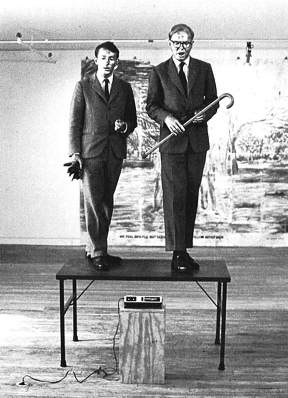
Gilbert & George's The Singing Scripture (1978). G&G first performed as human sculptures at several London art schools and two open-air rock concerts inthe late 1960's. In buttoned-up suits, with short hair and faces painted in metallic silver and gold, they struck robotic pose (mimicking the words of Edwardian music hall songs).

Pierre Molinier's The Spurr of Love (1966-68). Molinier depics himself as a hermaphrodite, a state of sacred perfection "transfixed for consumption by his own voyeuristic eyes."

Ana Mendieta's Silueta Series ( late 1970's). Mendieta's earth actions are metaphors for the stages of death and dissolution: "I have been carrying out a dialogue between the landscape and the female body (based on my own silhouette)."

Lynda Benglis (Untitled, 1974). The body as gender: Posing like a man in her car, or in a pin-up-style submissive role. Untitled was featured in Artforum and intended as a centerfold artist's statement.


Through the 1970's New York artist Hannah Wilke made a series of performalist self-portraits (entitled S.O.S) with her body being tainted by some disease. As it turns, Wilke was later diagnosed with lymphoma. She documented her ordeal of physical decline until the very end when she was no longer young and beautiful.

Orlan's Omnipresence (1993). Orlan's seventh "performance operation" was broadcast via live satellite from the Sandra Gering Gallery in New York to fifteen sites worldwide, including the Centre Pompidou, Paris, the McLuhan center, Toronto and the Multi-Media Center, Baniff. Spectators around the world could ask the artist questions before and after the intervention. The operation was performed by a feminist plastic surgeon, Dr. Marjorie Cramer, who inserted implants above Orlan's eyes and in her cheeks and chin. Orlan's "new face" was intended to idealized a different idea of physical female beauty.

Gina Pane's Sentimental Action (1973). "This aggressive ambiguity towards the body – whether practised by Stuart Brisley or Marilyn Manson – has always pulled in two opposite directions, both towards and away from Western civilisation. Tribal cultures have often adopted painful initiation rites. The film A Man Called Horse (1970) shows Richard Harris suspended by hooks pierced through his chest muscles in a scene that could have been directed by Fluxus artists, but is said to be a rigorously authentic depiction of the rites of Native Americans. The tattoo parlours of the East Village conjure up a myth of man’s tribal nature through Maori and Celtic-inspired designs, breaking with the idea of the city as a civilised, stable regime (tattoo parlours within New York were illegal until very recently and at least one of the city’s dominant religions, Judaism, expressly forbids tattooing). The practitioners call it body art, and it proclaims that the city is chaotic and tribal: a jungle, I suppose. Yet at the same time a part of me recognises that there are no initiation rites; no one is compelling today’s youth to attack or adorn their bodies. More than an expression of tribal identity, body art is another way to assert a Western identity: a love of liberty and individuality. And the method of asserting this identity is also very Western: drawing attention to the weak and mortal body in order to proclaim the nobility of the mind or the soul."--Nicholas Blincoe

Joseph Beuys's I Like America and america Likes Me (1974). For the opening of the Rene Block Gallery in New York, Beuys lived in the space together with a wild coyote named Little Joe for five days. Wrapped in felt on his arrival at JFK Airport and driven to the gallery by ambulance, Beuys entered the hay-strewn space holding a sheperd's staff. At the end of the five days, he returned to the airport as he had come.

Charles Ray's Plank Piece (1973). This work was an investigation of the plane that simultaneously divides and supports the body. Ray inserted his body into a simple equation of support, aligning the joints separating his pelvis from his torso and his calves from his thighs with the angle of connection between the wall and a plank laid against it.

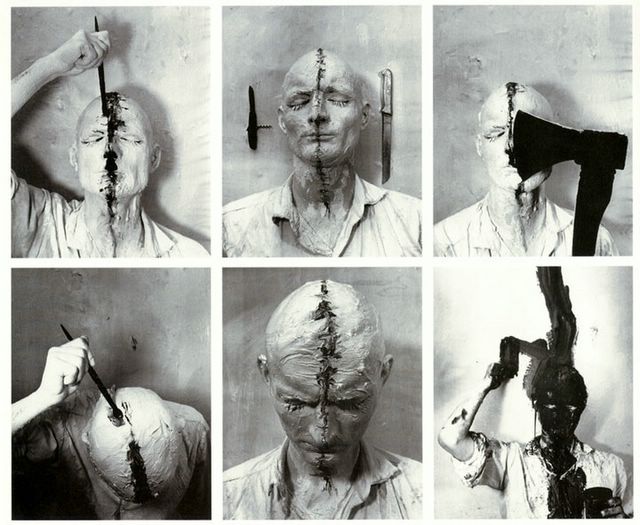
Günter Brus' Selfpain, Selfmutilation (1965). The central role Brus played in Vienna Actionism (1964-1970) is manifested in the radicalness with which he used his own body as a medium for his performances. As a consequence of these "actions" the artist had to leave Austria. This ended one day in a dance excess that I celebrated on a marble-topped cafe table. As I was about to herald the grand finale with a few hefty stomps, the marble top shattered...it was at the very least the chain of association — marble plate-marble cake-mummy cake-tummy cooking = shit — that made me drop my trousers and force out my bladder and belly refuse.-- GB

Yoko Ono's Cut Piece (1964). Ono sat on the stage and invited the audience to come up and cut away her clothing, covering her breasts with her hands as her garments fell away.

Carolee Schneemann's Meat Joy (1964): "Meat Joy has the character of an erotic rite: excessive, indulgent, a celebration of flesh as material: raw fish, chickens, sausages, wet paint, transparent plastic, rope brushes, paper scrap. Its propulsion is toward the ecstatic -shifting and turning between tenderness, wilderness, precision, abandon: qualities which could at any moment be sensual, comic, joyous, repellent."-- Carolee Schneemann

Hermann Nitsch's Orgiastic Performances (late 1960's). Nitsch's orgiastic performances, what he called 'total work of art' or Gesamtkunstwerk, looked a bit like Alan Kaprow's more secular happenings (in New York in the early 1960's). According to Nitsch, "In the fifties the most diverse artists from all over the world were confronted with the insufficiency of their respective media. They proceeded to ‘Aktionen’ and happenings with real events, that may be tasted, smelt, seen, heard and touched. This was the breakthrough to reality." Nitsch's endeavour to initiate this ritual of rituals must be seen against the broader background of the idea that art is the successor of religion. To phrase it in his own words: "To me, art is a kind of priesthood, since traditional religions have lost their spell." In a manifesto he says of the existential-sacral painting: "We strive for a consequent sacralisation of art and for a thorough spiritualization of existence whereby man becomes the priest of Being." In the end, the reality was slightly different; a handful of actors performing the 'orgiastic ecstasy,' gaped at by a handful of passive spectators, drinking, discussing, laughing and smoking…

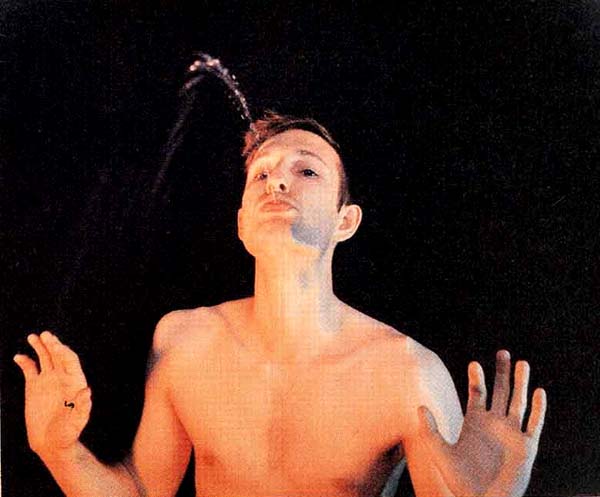
Bruce Nauman's Self Portrait as a Fountain (1966-67). Naumen made a series of photographs during a period of self-absorption in his studio. Posing as a self-generating fountain, an art object ejecting water into the air in a controlled stream from his pursued lips, Nauman parodied the traditionof public sculptors who represent the heroic male in poses validating his masculinity.

William Wegman's Family Combination (1972). "Family Combinations is a set of six photographs in two groupings. The first grouping is a series of portraits of the artist, his mother, and father. Framed in an identical manner, each member of the family stands in front of a white background and wears a plain dark shirt. Scientific in their approach, the photographs capture Wegman and his parents staring blankly past the camera. An analytic record of physical features, Wegman treats each face with a cool detachment. Taking his analysis to the next extreme, the artist combines the first set of images to produce the second, overlapping mother with son and father with mother. From left to right, father Wegman's nose bursts out of his son’s face, mother Wegman's hair sits atop the artist's head, and mother and father combined produce a head which looks nothing like their son. The father/mother combination is the last photograph of the six and is situated diagonally across from the straightforward portrait of Wegman that - if we are to read the series from left to right - is our starting point in the work. The disjunction between beginning and end, not to mention between an emotionally dry approach to photography and portraits of one's own family, are humorous paths into the work. With a deadpan expression similar to the 1920s film comedian Buster Keaton, Wegman's unsmiling face masks a whimsical fascination with his own identity and with the medium of photography."-- Taken from a PBS essay on Wegmann's Family Combination.

Yasumasa Morimura's Self-Portrait After Marilyn Monroe (1996). Morimura burst onto the international art scene about 10 years ago with his "Art History" series, computer-aided reconstructions of great Western paintings that featured the artist’s big-nosed face replacing the faces of the works’ original subjects. The high-tech Japanese kitsch was embraced by a Western world passing through a period of growing interest in sushi, economic miracles, and things Japanese in general, and Morimura became somewhat of a superstar both at home and abroad. His more recent work has featured the artist made-up as Hollywood starlets, and has won the Osaka-based artist solo shows at the Museum of Contemporary Art, Chicago, the Yokohama Museum of Art, and ensured his inclusion in major group shows at scores of important galleries and museums around the world.

Saturday, February 17, 2007

Clamor and Zero Hero

Thursday we had the opportunity to see two very different shows: CLAMOR by Allora & Calzadilla, and Zero Hero by John Bock. Silvia's presentation was convincing. She talked about war, military music, Vieques, Minimalism, performance art, Viennese Actionism, Arte Povera, Fluxus, etc. It was an unique opportunity: One of Miami's best curators just for ourselves (inside the empty space of the gallery). What are your thoughts?

Monday, February 12, 2007

UPDATE: THIS THURSDAY

We've received an invitation from Silvia Cubina (the director at the Moore Space) to visit her space this Thursday at 7:15pm! Silvia will talk about their actual show, CLAMOR.

I propose that we meet in the same place (at Merrick 309 A, at 6:20pm) and then leave for the gallery. We can car pool to the venue, which is only 20 minutes away. Please, leave a comment here in case you need anything (I can comfortably fit three of you in my car).

Moore Space
4040 NE 2nd Avenue
(second floor)
305.438.1163

Friday, February 9, 2007

Massengale

Massengale's presentation of his work last night was intense. If you want to share something here, it would be nice. Believe it or not, sometimes they read this blog.

Thursday, February 8, 2007

Advertising

1- Though it's true that propaganda and advertising are both ways to sway public opinion, they are not the same thing. Because of the totalitarian justification of propaganda as a valuable tool to advance and legitimize the interests of the ruling party (Lenin, Goebbels, Plekhanov, etc), the term has strong political overtones. On the other hand, advertising uses techniques and practices to bring products, services, opinions, even causes to public notice for the purpose of persuading the public to respond in certain ways. In a Capitalist system, most advertising involves promoting “goods for sale,” but similar methods are used to encourage people to drive safely, to support various charities, or to vote for political candidates, among many other examples. 2- Advertising is late-Capitalism’s most important source of income for the media (e.g., newspapers, magazines, or television stations). 3- The most basic media for advertising are: (a) Newspapers (offers large circulations, a readership located close to the advertiser's place of business, and the opportunity to alter content on a frequent and regular basis), (b) Magazines (of general interest, aimed at specific audiences), (c) TV and radio. For advertisers the most important facts about a TV or radio program are the size and composition of its audience (size determines the amount of money the broadcaster can charge; composition determines the advertiser's choice as to when a certain message should be run). (d) Other minor media are direct mail, outdoor billboards, posters, transit advertising (which can reach the millions of users of mass-transit systems) and even smaller items, such as matchbooks or calendars. 4- Advertising will be effective if its production -and placement- is based on a knowledge of its target, plus a skilled use of the media. Advertising agencies can orchestrate complex campaigns (whose strategies are based on research into consumer behavior and demographic analysis). So, the marketing side of advertising employs publicity to achieve its aim. 5- There’s no question that advertising is a powerful way to inform consumers. In a free-market economy effective advertising is essential to a company’s survival, for unless consumers know about a company's product they are unlikely to buy it. In criticism of advertising it has been argued that the consumer must pay for the cost of advertising in the form of higher prices for goods; against this point it is argued that advertising enables goods to be mass marketed, thereby bringing prices down. 6- It has been argued that the cost of major advertising campaigns is so high that it stimulates oligopolies. 7- Finally, there’s the issue of “undue influence,” false advertising and the use of deceptive techniques such as concealment of facts, exaggeration and other psychological appeals.
“Today marketers continue to use more sex in advertising for a greater range of products. For example, a recent ad in Linux Journal for computer hardware products featured the face of an attractive woman and this headline: “Don't feel bad, our servers won't go down on you either. ” Although one could say that the ad is sexist, it represents a use of sexual imagery and double entendre used to sell a brand not traditionally linked to sex. At the same time, brands traditionally associated with sex appeals —designer clothing and accessories, alcohol, and “better sex” videos— appear to be featuring sexual imagery that is increasingly explicit.”—Sex in Advertising, Jacqueline Lambiase & Tom Reichert (Earlbaum Associates, 2003).

Did you know about the Buy Nothing Day or TV Turn Off Week? What do you think about these anti-commercial techniques?

A Marlboro Ad from the 1960’s. It identifies the brand with a particular place: “Marlboro Country.” The epic music and the slow gallop of the horses amalgamate with the cool and tough profile of the cowboy smoking a cigarette.

This Adbusters commercial is straightforward and true (though I wonder if people would stop eating burgers at McDonald after they see it).

As this ads against polio proves, a powerful message can be conveyed in a simple manner.

Do you think this ad is more effective because of the erotic depiction of the female body? If so, what sort of message does it portray?

Stylistically speaking, René Rodriguez and Frank Miller's Sin City works so well because it remains faithful to the visual style of noir (fast paced, violent, gritty and stereotypical), while treating it as a parody. See how self-conscious the art of poster has become, after the style of photo realism took over Hollywood: Walk into a Blockbuster store and just glance over hundreds of titles. They all look the same.


Otto Preminger's Laura (1944). This is a typical poster for a film noir of the epoch. The idea is to display the "stars" while suggesting the film’s plot (not an easy task). In order to keep a compositional balance, the designer would present the figures in different sizes (depending that character's function in the movie) along with the lettering. The message was as important as the images. The man in charge for the art direction was Leland Fuller, who won Best Interior Design for Laura.

Without Saul Bass (1920-1966) Otto Premiger's The Man With the Golden Arm (1956) would not have the same visual appeal. Bass created a style for movie credits. His design for this famous sequence borrows from Bauhaus and a bit of Constructivism (the music score is by Elmer Bernstein). Bass went on to work with Hollywood luminaries such as Hitchcock (in "Vertigo" and "Psycho"), Robert Aldrich ("The Big Knife"), Kubrick ("The Shining") and Scorsese ("GoodFellas"). Bass was born in the Bronx, and studied with Gyorgy Kepes, a hungarian designer and disciple of Moholy-Nagy.

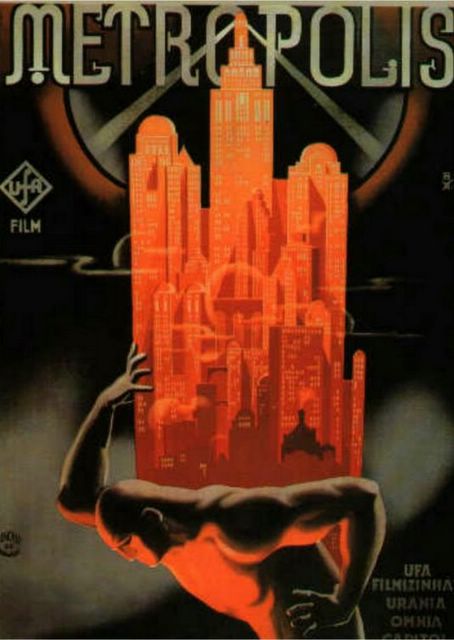
Fritz Lang's Metropolis (1927). Though Lang’s masterpiece has an Expressionist feeling, the design for the poster uses a modern nouveau style. It is said that with Metropolis, Lang wanted to make a "futurist film."
The ad suggests a link between fashion and Nissan’s new car, the Micra. A busy young female (a Japanese designer?) moves around in a stylish little car (giving the final touches to mannequins in a shop window). At the end of the clip we read: “Cities are made for Micra,” along with a view of the Eiffel Tower (a symbol of cosmopolitanism).

A Spielberg-like theme (to the music of John Williams): The ibook not only empowers the girl to move things from a distance inside her room, but to finish her chores right on time. The ad has a definite family appeal (who buys the ibook?).