Thursday, November 16, 2006


Art prices were relatively stable between the two world wars, but they began to rise in the 1950s. Prices for Pablo Picasso's works were thirty seven times higher in 1969 than in 1951, and prices for Marc Chagall's works rose fiftyfold over that period. The increase in the price of art was especially dramatic after 1983, with prices peaking between 1987 and 1990 and then falling somewhat after 1990. Picasso's Yo Picasso sold at auction in 1989 for $47.9 million, twice the pre-auction estimate and eight times what it sold for in 1981. Jasper Johns' False Start sold in 1960 for $3,150; in 1988, it brought $17.5 million at auction. From 1975 until the late 1 980s, works by the following artists recorded these price increases: Jackson Pollock, 750 percent; Pierre-Auguste Renoir, 490 percent; Claude Monet, 440 percent; Edgar Degas, 350 percent; Camille Pissarro, 220 percent; and Alfred Sisley, 220 percent. Even works by more obscure painters have skyrocketed: from 1975 to 1988, prices for watercolors by English artist Thomas Girtin increased by 310 percent, prices for paintings by Swedish artist Bruno Liljefors rose by 340 percent, and prices for works by Scotland's J. D. Fergusson appreciated by 460 percent.-- John E. Conklin, Art and Crime, (Praeger Publishers, 1994).

Even in a crowd, the visual arts encourage a capacity to work in solitude. The artist’s eye is always seeing, sensing and feeling the atmosphere around at that moment. If the inner peace for such exploration is not present in the person or persons we are working with in our initial contacts, we can at least see such peace of mind as part of our goal in introducing visual arts sessions. In this hectic, fast-paced world, all people can gain from knowing greater inner peace. Such peace comes from self-knowledge and an appreciation of each person’s unique, individual, creative mark which may in turn provide opportunities for increasing self-confidence and self-esteem. The wonderful beauty of the arts, in all forms, is that human emotion is involved in a raw and uncensored manner. Feelings flowing are essential for artistic experience. The professional artist and the inexperienced participant have in common the fact of being at their best as creators of visual imagery by their capacity to tap the unconscious and, as a result, to present in line, colour and form a mark that is individually their own, unable to be produced by any other individual in exactly the same way, ever. -- Bernie Warren, Using the Creative Art in Therapy, (Routledge, 1993).

Justice Potter Stewart of the U.S. Supreme Court gave a celebrated response to the question of pornography: "I don't know how to define it, but I know it when I see it." This fairly common remark characterizes the state of confusion that ensues whenever we attempt to define pornography, and it seems to have persisted longer than any definition yet offered. The problem of definition was nowhere nearer to a solution when a panel of experts on pornography, incuding Erica Jong of Fear of Flying fame and Al Goldstein, publisher of Screw magazine, met and discussed the issue for Harper's magazine. The panel launched into an exhaustive probe of pornography but, as expected, could not come to anything resembling an answer. Goldstein, whose attitude toward the subject is nothing if not straightforward, summarized the conclusion in this inclusive statement: "The problem with pornography is that no one really knows what it is, no one knows where to draw the line that separates it from other forms of expression."--Jon Huer, Art, Beauty and Pornography (Prometheus Books, 1987)
From here on, let's look at the following: 1- Physical environment, 2- Medium in which the craftsman works, 3- Materials and techniques, personality of the artist, 4- The artist's role in society, 5- The nature of the visual language artists use, 6- The visual forms to which the artist has been exposed and 7- The nature of the aesthetic canon by which the creative process is guided and judged.-- Evelyn Payne Hatcher, Art as Culture: An Introduction to the Anthropology of Art (Bergin & Garvey, 1999).

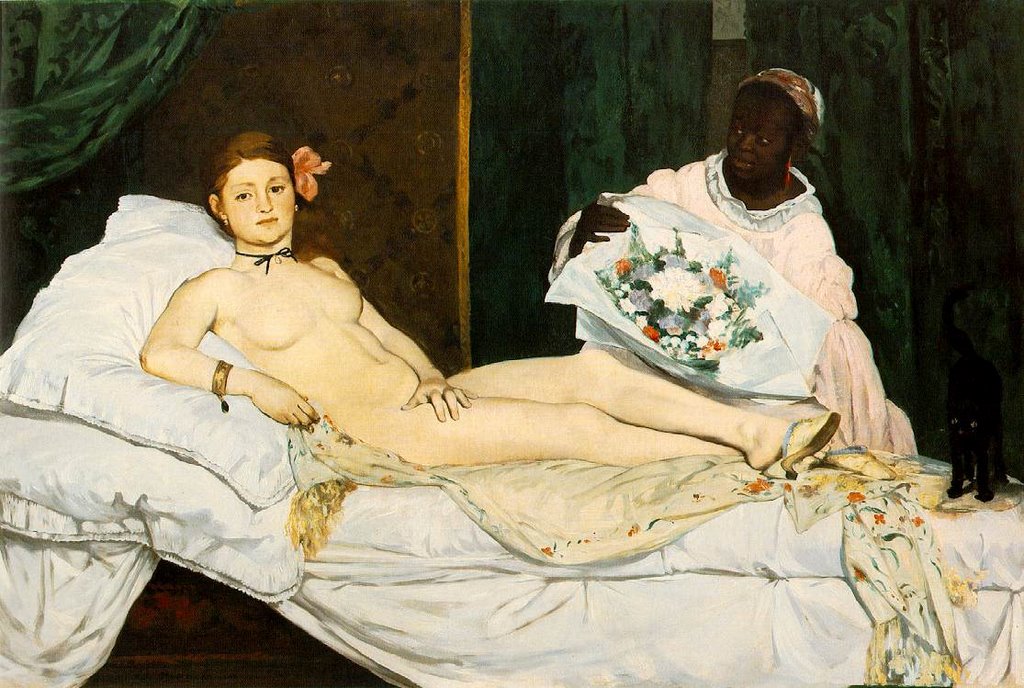
Perhaps they have internalized and are cooperating with the West's construction of not-white women as not-to-be-seen. How could they/we not be affected by that lingering structure of invisibility, enacted in the myriad codicils of daily life and still enforced by the images of both popular and high culture? How not get the message of what Judith Wilson calls "the legions of black servants who loom in the shadows of European and European-American aristocratic portraiture," of whom Laura, the professional model that Edouard Manet used for Olympia's maid, is in an odd way only the most famous example? Forget euphemisms. Forget "tonal contrast." We know what she is meant for: she is Jezebel and Mammy, prostitute and female eunuch, the two-in-one. When we're through with her inexhaustibly comforting breast, we can use her ceaselessly open cunt. And best of all, she is not a real person, only a robotic servant who is not permitted to make us feel guilty, to accuse us as does the slave in Toni Morrison Beloved (1987). After she escapes from the room where she was imprisoned by a father and son, that outraged woman says: "You couldn't think up what them two done to me," Olympia's maid, like all the other "peripheral Negroes," is a robot conveniently made to disappear into the background drapery. --Lorraine O'Grady, New Feminist Criticism: Art, Identity, Action (Icon Editions, 1994 ).

Wednesday, November 15, 2006

Update

Tomorrow, artist Carlos de Villasante will visit ART 106.

Friday, November 10, 2006

Maritza Molina

Maritza Molina’s presentation was interesting because as it turns, we’ve talked about issues that -even tangentially- touch her work: Performance, the use of the body as vehicle for self-expression, Feminism, etc. Is there a distinction between photography as such and the documenting of a performance? What do you think?

Is it art?

Last night, Jessica’s question (about Thomas Kinkaid’s work being art) started an interesting conversation that we couldn’t finish. I’d like to put my ten cents: Let’s start with Arthur Danto’s suggestion that a definition of art cannot be given “a priori” (that is, independent of the experience of artworks) because art can only be measured against artistic production. Some people believe that art is only “one thing” and that's it (i.e., an object should not be considered “art” if it doesn’t fit such model). That approach is limited. Why? Say you live in 1940’s New York. The art of the moment is Abstract Expressionism (coming from prior European modern traditions in Europe). How would you have received a 1965 exhibit at MOMA entitled The Responsive Eye, showing so-called “Op Art?” If you were establishment, you’d have rejected it –as many well-known critics (Greenberg, Barbara Rose, Thomas Hess) did. Why? It didn’t fit the norms. Yet, today, Op Art is recognized as an important post-war art movement. How to avoid this pitfall? We know Praxiteles excelled among Athenian artists. He had remarkable craft and personal style. The reason we value his art as “canonical” is that he “fits” the tenets of Greek tradition, yet was able to push this tradition a little bit. From Praxiteles’ model, I’d like to suggest a tentative criterion for assessing “good” art: 1- Craft (meaning technical skill, proficiency), 2- Personal style (individuality that enriches and yet “fits” a given tradition), 3- The acknowledgment of peers. In a more distant place, 4- Being accepted in the canon. To judge a given work one must apply the four elements together. Now, to answer the initial question I’d like to bring forth Miami’s Romero Britto. Does he produce art? Most people in the art scène would say, “Of course not.” But Britto’s work has a personal style; his craft is what it is (I’d say that he executes it properly). Finally, though the critics don’t accept him, he’s famous and figures in many important collectors’ collections. He has some degree of peer recognition but his work has yet to survive the canon. Will it? I don’t know. We have to wait. In the meantime, is it art? Possibly. Is it good? Surely not as good as that of other Pop artists, like Warhol, Ruscha and Lichtenstein, whose influence in Britto's work is quite clear. Naïve? Decorative? It depends what you’re looking for. Sometimes you crave a Big Mac instead of a Lobster Termidor; sometimes you want a cheap Tempranillo to down a tapa instead of a Burgundy. Now, apply that method to Kinkaid's work.

Wednesday, November 8, 2006

Update

Miami-based performance artist Maritza Molina will visit our class tomorrow. Since there's a student show, I'm thinking we can meet in Merrick 309-A as usual, go to the show and then come back in time for Maritza's presentation.

Saturday, November 4, 2006

Kelly Flynn's Show

I'm proud to announce Kelly Flynn's exhibition of photographs, on November 11th, at Chelsea Galleria. Kelly is in our Art 106 class. We'll be there to support her. Chelsea Galleria, 2441 NW 2nd Avenue, Wynwood Art District. (305)576.2950

Friday, November 3, 2006

Pollock reigns!

Jackson Pollock's No. 5, 1948 just sold for a record $140,000,000. Keep working, you can make it!

Adler

Adler’s presentation was characterized by a contained intensity. I felt he really tried to express something one does not hear often about the uneasy relationship we have with the city. His idea of “in-betweness” stayed with me all night (as well as giving peoples and places the opportunity to exude beauty). I think his art is so much in tune with Baudelaire that he becomes the flâneur! What do you think?

Thursday, November 2, 2006

Art & Society


Art does not happen in a vacuum. There is always a particular social milieu in which art is produced. Each culture has a distinct social organization of artistic activities that is associated with a specific attitude of artists toward their work (for example French Cubism happens in a different socio-political climate than Russian Constructivism). Artistic cultures arise from artists' relationships with other artists, their audiences; from their involvements with cultural systems not specifically artistic, from artists' technologies and ideologies. A change in any of these variables (no matter how small) can modify a given culture and give rise to new variants of it (as per the difference between Cubism and Italian Futurism).


The professional artist chooses what to make (she produces in order to sell). She is a specialist, competent in the techniques of her craft. In the visual arts, the professional artist works in her own studio, at times of her own choice. In the artistic profession, is not the ownership of the means of production that matters so much as the artist's sense that she rules upon her personal aesthetic sense. This is the predominant image of the artist in modern Western societies.


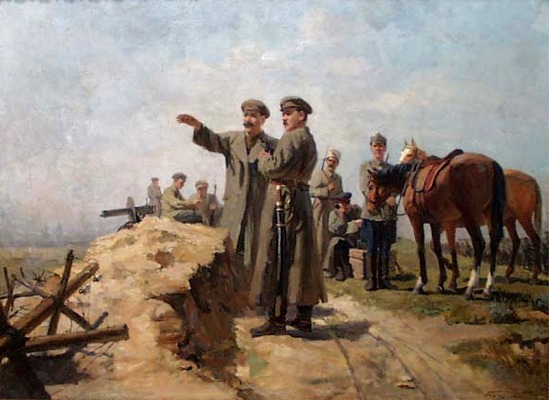
Totalitarian regimes provide the best examples of what happens when a modern artistic enterprise is subordinated to a political ideology. Artists are forced back into sort of clerical roles, with the difference that the ideology is imposed on them. Even when it does correspond with their ideological views, it conflicts with the conception of the professional role that they regard as their primary orientation within the sphere of art (as Maikovsky's disenchantment with the Bolshevik Revolution). Above, an example of the so-called Socialist Realism.


More recently, a third avant-garde has emerged: The anti-artistic avant-garde, which is alienated from the very notion of art and its practice as it's received in other versions of the avant-garde culture. Art itself and its academic extension, is perceived as "oppressive" and "exploitative," and the obligation of the artist (and of the art critic) is seen as the promotion of the "end of art". The very coherence of art is felt to be an imposition of an arbitrary system on the immediacy of "aesthetic experiences," which are to be pursued with a self-conscious repudiation of any deliberate control.


Political avant-garde culture: The artist sees himself/herself as alienated from "oppressive" and "exploitative" political and economic institutions and tries to create a new kind of art intended to undermine these institutions (German poet and playwright Bertolt Brecht is an example). The bohemian and the political avant-garde overlap, and over time, one may change into the other.

Bohemian avant-garde culture: One of the distinguishable types of this artistic culture is the bohemian avant-garde, which tends to be alienated from all rational and utilitarian aspects of social organization and cultural tradition and aims to create a new kind of exaggeratedly irrational art and, perhaps even more important, an irrational style of life. (Typical of this group is the French poet and critic Charles Baudelaire.) Its behaviour centres on the ambivalent and the self-consciously paradoxical: a tradition of pursuit of the new, the cultivation of a pleasureless hedonism, the development of systems for the liberation of spontaneity.


Artist as "genius": As conjunction of the artisan, clerical, and courtly cultures, the cult of genius emerged in the early 16th-Century during the High Renaissance and became fully developed in the age of Romanticism -at the beginning of the 19th century. The artist conceives himself as the "unacknowledged legislator of the world" (in the words of the English poet Percy Shelley), an autonomous, godlike creator of new orders of reality obedient only to his perceptions and the categories of his mind. He creates the unifying symbols of a developing civilization. Historically, the "genius" is the precursor of the professional artist of the 20th-Century. Artists like Raphael, Michelangelo, Mozart, Byron, Beethoven, Delacroix, etc, are notable examples.


The courtly artist is a craftsman of ordinary social standing, directly dependent upon a secular royal court -or a household of the high nobility. He is usually socially involved with this household as a vassal, royal favorite, or court artist. He produces for the high aristocracy for which he works, without actually being a member of it. The artist is ennobled by his art, permeated with "noble" attitudes: heroic exaltation, fashionable late-medieval despair, or refined Rococo or Rajput sensuousness. Artists like Rubens, Velazquez, Goya, David, are salient examples.


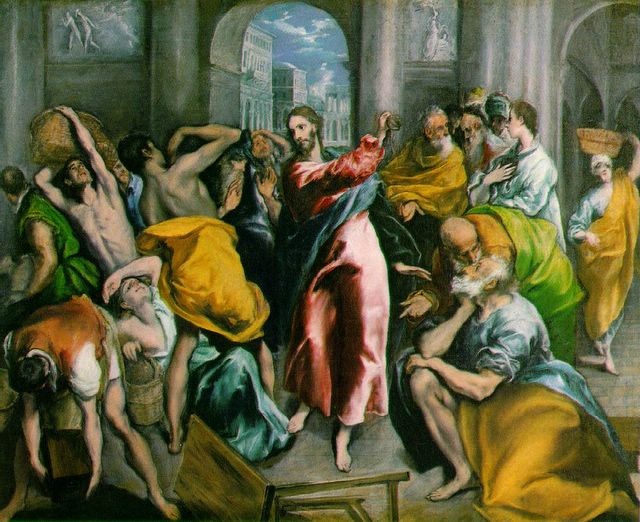
The clerical artist is very much a craftsman, subordinated to a moral community, which he is committed to serve and to defend by his work. By his association with this tradition, the artist gains in prestige, but also acquires a moral responsibility which the pure craftsman is not bound by. The clerical artist belongs to a moral community, which provides him with criteria for judging which works of art are worth making. He is submissive to the discipline of the moral community of which he is a part. Boticelli, Raphael, El Greco, Zurbaran, are examples of artists in the service of the church.


The artisan is a member of a specialized collectivity, such as a guild or a workshop set up by a state or a church -who works on order and for pay only. Such artist develops the pride of good craftsmanship and habits of regularity and reliability in his work and does whatever style or content is required by the client.

Folk artists are nonspecialized members of their community and closely involved with all of its activities. Their art has symbolic elements which define and give shape to the community. The themes are linked with folktales, abstract stylization (geometric ornamentation of utensils). This artist lives more powerfully in her imagination than the rest of the group. She creates by following traditional patterns. Much art is produced spontaneously for oneself, or in friendship or for communal enjoyment, rather than for pay.

Tuesday, October 31, 2006

Artist Adler Guerrier is coming this Thursday. It should be an interesting presentation.

Sunday, October 29, 2006

Update

1- Below, find this week's issue. 2- This week is pretty hectic for me, so I'm going to ask you to post your comments by Wednesday 12 noon (at that time the post comments-section will be closed). 3- For those applying for writing credit, it would be better if you could send me an earlier draft (via email). 4- By the way, how was Carlos?

Saturday, October 28, 2006

The art market

For the last few years, the media have trumpeted contemporary art as the hottest new investment. At fairs, auction houses and galleries, an influx of new buyers--many of them from the world of finance--have entered the fray. Lifted by this tidal wave of new money, the number of thriving artists, galleries and consultants has rocketed upwards. Yet amid all this transformative change, one element has held stable: the art market's murky modus operandi. In my experience, people coming from the finance world into the art market tend to be shocked by the level of opacity and murkiness," says collector Greg Allen, a former financier who co-chairs MoMA's Junior Associates board. "Of course, there's a lot of hubris--these people made fortunes cracking the market's code, so they tend to think the opacity is someone else's problems. But the mechanisms are not in place to eliminate ethical lapses or price-gouging, and the new breed of collectors is definitely more likely to pursue legal options. And once things go to court, a lot of the opacity gets shaken out." The art trade is the last major unregulated market," points out Manhattan attorney Peter R. Stern, whose work frequently involves art-market cases. "And while it always involved large sums of money, there was never the level of trading and investing that we have now. I'm increasingly approached by collectors who have encountered problems." Stern represented collector Jean-Pierre Lehmann in his winning case against the Project Gallery, which captivated the art world by revealing precisely what prices and discounts Project Gallery Chief Christian Haye had offered various collectors and galleries on paintings by Julie Mehretu--information normally concealed by an art world omerta. --Time To Reform The Art Market? by Marc Spiegler for The Art Newspaper, 2006.

Monday, October 23, 2006

Update

I need your inputs for this week's issue (Female Art) and that's it (as far as homework goes). 1- "It sounds like a paradox, but it is a very simple truth, that when to-day we look for 'American art' we find it mainly in Paris. When we find it out of Paris, we at least find a great deal of Paris in it." That's Henry James, observing the state of American art in 1887. 2- David Lock wins the Art on Paper Award. 3- Thefts from the Hermitage? 4- Artist Carlos Betancourt is coming on Thursday. It should be fun.

Sunday, October 22, 2006

Female art

First, we would have to make a distinction between female art and Feminist art. Whereas the first is a label for art made by women, the latter addresses very specific socio-political issues regarding the exploitation of women by men. Feminism is right about the suppression and dislocation of women from the public sphere (since the Renaissance until the end of the Twentieth Century; just look at the disproportion of male and female artists in Modern art history). 1- An important alert to feminist issues came in the 1970’s, with artist Judy Chicago’s The Dinner Party, a work that used several traditionally “feminine” art-mediums to teach women’s history (Chicago’s work represents the ways in which feminists began to explore their oppression through art). Why is it that the early avant-garde (Impressionism, Post-Impressionism, Fauvism, Expressionism, Futurism, De Stijl, etc) were essentially male-driven movements? I don’t want to dwell in the causes of this phenomenon, which has been well-documented by Feminists such as Simone De Beauvoir in The Second Sex, Shulamith Firestone’s The Dialectics of Sex or Carol Gilligan’s In a Different Voice, among many others. 2- Since the 1960’s female art has brought forth a new attention to materials: ceramics, latex, rubber, fiberglass and yarn. There is a return to fiber media: weaving, quilt-making, etc. Formally, female art is generally characterized by a biomorphic, more fluid focus. In performance/art, video and photography, women have explored gestures of objectification and exploitation from a different perspective than those found in male performances (which tend to be more heroic). 3- Although art is universal, the claim that art has no gender is not necessarily true (See post-feminism). Can you think of particular female art themes? Go ahead.

Elke Krystufek's "Silent Scream" (2000's). Elke Krystufek emerged in the early '90s with in-your-face performances and installations dealing with femininity and sexuality as filtered through pop culture. Taking her cue from '70s body art--particularly its Viennese branch-Krystufek uses her own image, often distorted, debased, disguised, or made sexually explicit, to confront viewers with collective (and mostly suppressed) revulsions and desires. Krystufek’s art is about herself, her ego and her life. For ten years now, her impertinent performances have exhibited a voyeuristic/exhibitionistic dynamic that dissolves the boundaries between the public and private realms.

Tuesday, October 17, 2006

No class this Thursday

Dear kids: Due to personal problems, I will not be able to make it to our ART 106 class. We're not meeting this Thursday. Tomorrow I’ll post a take-home for next Thursday.

More erotica

Talking about masterful, academic, virtuosistic, detailed-oriented erotica!

Friday, October 13, 2006

K.H.

K.H.'s presentation left me wondering about the many different facets of this thing we call art criticism (she kept talking about "community"). What are your thoughts?