Saturday, October 28, 2006
The art market
For the last few years, the media have trumpeted contemporary art as the hottest new investment. At fairs, auction houses and galleries, an influx of new buyers--many of them from the world of finance--have entered the fray. Lifted by this tidal wave of new money, the number of thriving artists, galleries and consultants has rocketed upwards. Yet amid all this transformative change, one element has held stable: the art market's murky modus operandi. In my experience, people coming from the finance world into the art market tend to be shocked by the level of opacity and murkiness," says collector Greg Allen, a former financier who co-chairs MoMA's Junior Associates board. "Of course, there's a lot of hubris--these people made fortunes cracking the market's code, so they tend to think the opacity is someone else's problems. But the mechanisms are not in place to eliminate ethical lapses or price-gouging, and the new breed of collectors is definitely more likely to pursue legal options. And once things go to court, a lot of the opacity gets shaken out." The art trade is the last major unregulated market," points out Manhattan attorney Peter R. Stern, whose work frequently involves art-market cases. "And while it always involved large sums of money, there was never the level of trading and investing that we have now. I'm increasingly approached by collectors who have encountered problems." Stern represented collector Jean-Pierre Lehmann in his winning case against the Project Gallery, which captivated the art world by revealing precisely what prices and discounts Project Gallery Chief Christian Haye had offered various collectors and galleries on paintings by Julie Mehretu--information normally concealed by an art world omerta. --Time To Reform The Art Market? by Marc Spiegler for The Art Newspaper, 2006.
Monday, October 23, 2006
Update
I need your inputs for this week's issue (Female Art) and that's it (as far as homework goes). 1- "It sounds like a paradox, but it is a very simple truth, that when to-day we look for 'American art' we find it mainly in Paris. When we find it out of Paris, we at least find a great deal of Paris in it." That's Henry James, observing the state of American art in 1887. 2- David Lock wins the Art on Paper Award. 3- Thefts from the Hermitage? 4- Artist Carlos Betancourt is coming on Thursday. It should be fun.
Sunday, October 22, 2006
Female art
First, we would have to make a distinction between female art and Feminist art. Whereas the first is a label for art made by women, the latter addresses very specific socio-political issues regarding the exploitation of women by men. Feminism is right about the suppression and dislocation of women from the public sphere (since the Renaissance until the end of the Twentieth Century; just look at the disproportion of male and female artists in Modern art history). 1- An important alert to feminist issues came in the 1970’s, with artist Judy Chicago’s The Dinner Party, a work that used several traditionally “feminine” art-mediums to teach women’s history (Chicago’s work represents the ways in which feminists began to explore their oppression through art). Why is it that the early avant-garde (Impressionism, Post-Impressionism, Fauvism, Expressionism, Futurism, De Stijl, etc) were essentially male-driven movements? I don’t want to dwell in the causes of this phenomenon, which has been well-documented by Feminists such as Simone De Beauvoir in The Second Sex, Shulamith Firestone’s The Dialectics of Sex or Carol Gilligan’s In a Different Voice, among many others. 2- Since the 1960’s female art has brought forth a new attention to materials: ceramics, latex, rubber, fiberglass and yarn. There is a return to fiber media: weaving, quilt-making, etc. Formally, female art is generally characterized by a biomorphic, more fluid focus. In performance/art, video and photography, women have explored gestures of objectification and exploitation from a different perspective than those found in male performances (which tend to be more heroic). 3- Although art is universal, the claim that art has no gender is not necessarily true (See post-feminism). Can you think of particular female art themes? Go ahead.

Elke Krystufek's "Silent Scream" (2000's). Elke Krystufek emerged in the early '90s with in-your-face performances and installations dealing with femininity and sexuality as filtered through pop culture. Taking her cue from '70s body art--particularly its Viennese branch-Krystufek uses her own image, often distorted, debased, disguised, or made sexually explicit, to confront viewers with collective (and mostly suppressed) revulsions and desires. Krystufek’s art is about herself, her ego and her life. For ten years now, her impertinent performances have exhibited a voyeuristic/exhibitionistic dynamic that dissolves the boundaries between the public and private realms.
Tuesday, October 17, 2006
No class this Thursday
Dear kids: Due to personal problems, I will not be able to make it to our ART 106 class. We're not meeting this Thursday. Tomorrow I’ll post a take-home for next Thursday.
Friday, October 13, 2006
K.H.
K.H.'s presentation left me wondering about the many different facets of this thing we call art criticism (she kept talking about "community"). What are your thoughts?
Thursday, October 12, 2006

Balthus' Nude With Cat (1949). The work of Balthus does not fit neatly into an art historical category and he deliberately discourages the classification, preferring each viewer to appreciate his paintings directly. This does not imply that he worked in a vacuum, free from discernable literary and artistic influences, but more his desire to be considered as an individual rather than a member of a movement or part of an established style. A number of themes or subjects do recur in his art, the most important being depictions of prepubescent female figures. While such works are not devoid of an erotic content they are actually a coherent examination of burgeoning sexuality. Nude with cat is a study of unselfconscious sensuality, and whether the intimacy is regarded as overly confronting is very much left to the viewer, as the artist intended.

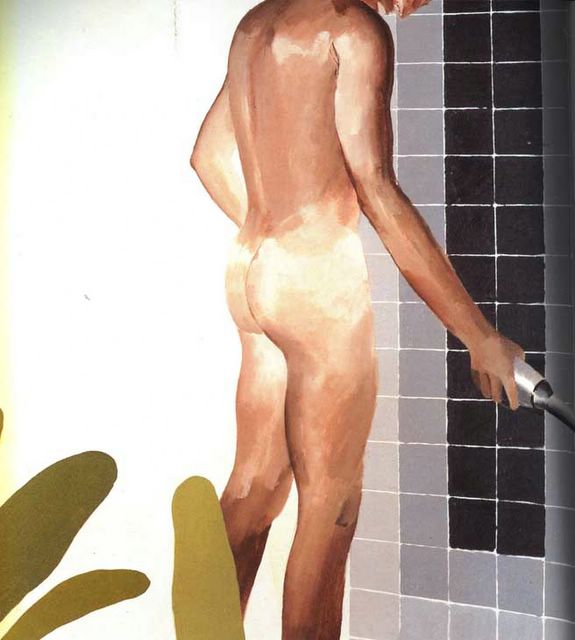
David Hockney's Man Taking a Shower (1966): "Hockney's vision . . . is stamped by his homosexual stance. In one sense, this undoubtedly limits his work: those of us who are not homosexual will never simply feel the same way about those delicate pink lines with which he tints the buttocks in his otherwise black-and-white drawings of young boys."-- Peter Fuller, Art Monthly, no. 49, September 1981.
 (This paragraph is taken from Wikipedia): Michelangelo's The Last Judgment was an object of a heavy dispute between Cardinal Carafa and Michelangelo: The artist was accused of immorality and intolerable obscenity, having depicted naked figures, with genitals in evidence, so a censorship campaign (known as the "Fig-Leaf Campaign") was organized by Carafa and Monsignor Sernini to remove the frescoes. When the Pope's own Master of Ceremonies, Biagio da Cesena, said "it was mostly disgraceful that in so sacred a place there should have been depicted all those nude figures, exposing themselves so shamefully, and that it was no work for a papal chapel but rather for the public baths and taverns," Michelangelo worked da Cesena's semblance into the scene as Minos, judge of the underworld. It is said that when he complained to the Pope, the pontiff responded that his jurisdiction did not extend to hell, so the portrait would have to remain.

Caravaggio's Amor Vincit Omnia (1601). Much scholarly and non-scholarly ink has been spilled over the alleged eroticism of the painting. Yet the homoerotic, not to say pederastic, content was perhaps not so apparent to Giustiniani’s generation as it has become today. Naked boys could be seen on any riverbank or seashore, and the eroticisation of children is very much a cultural artefact of the present-day rather than Caravaggio's. -- Fragment taken from the Wikipedia

John Singer Sargent's Madame X (1884). The painting was exhibited at the Paris Salon of 1884 as Portrait de Mme *** and created a scandal. It's considered one of Sargent's best works: "The Salon was in an uproar. Here was an occasion such as they had not had since Manet's Le dejeuner sur l'herbe and L'Olympia. The onslaught was led the lady's relatives. A demand was made that the picture should be withdrawn. It is not among the least of the curiosities of human nature, that while an individual will confess and even call attention to his own failings, he will deeply resent the same office being undertaken by someone else. So it was with the dress of Madame Gautreau. Here the distinguished artist was proclaimed to the public in paint a fact about herself which she had hitherto never made any attempt to conceal, one which had, indeed, formed one of her many social assets. Her sentiment was profound. If the picture could not be withdrawn, the family might at least bide its time, wait till the Salon was closed, the picture delivered, and then by destroying, blot it as an unclean thing from the records of the family. Anticipating this, Sargent, before the exhibition was over, took it away himself. After remaining many years in his studio it now figures as one of the glories of the Metropolitan Museum in New York".-- Evan Charteris, John Sargent, Benjamin Blom, NY, 1927
Tuesday, October 10, 2006
Update
Are you into gardening? This Thursday, Kathleen Hudspeth is coming to class. Among other things, she'll talk about The Next Few Hours, arguably Miami's best art blog.
Friday, October 6, 2006
Thursday, October 5, 2006
Body Art
Over the course of the last 50 years, artists have investigated the aesthetic frontiers of the body. A central notion of human identity, the idea of the physical body and the human self -as stable - has eroded (think of two world wars, the Holocaust, Viet-Nam, AIDS, plus the redefinition of the body in light of the developments in psychoanalysis, philosophy, anthropology, medicine, etc). Artists have investigated the temporality, contingency and instability of the body within and beyond cultural boundaries. One can generally define several areas of investigation: 1- The gesturing body, or the performing body: A dual role of object and subject that becomes public and gets transformed by activism (here we have the FLUXUS performances of Ono, Klein, Beuys, Nauman, etc). 2- The ritualistic body, as one finds in the Viennese Actionists' use of the symbolic language of torture, slaughter and sacrifice (among them Günter Brus, Hermann Nitsch and Otto Mühl, as a way to deal with the horrors of post-War Nazi Austria). Or the self-mutilated body of Gina Pane and Mike Parr and the dying body -as bravely documented by Hannah Wilke. Also the desecrating body (as in Serrano’s Piss Christ). 3- The body as "participatory," as in Chris Burden's symbolic antics, Carolee Schneemann performances and Yayoi Kusama's staged "orgies." 4- The body as identity; whether expanding the idea of gender (the transgender phenomenon), sexuality or race, identity is characterized as a cipher in constant evolution (through the use of props, masks, costumes or any other disguises). In this category, we have the works of Pierre Moliniere, Lynda Benglis, Laura Aguilar, Paul McCarthy and others. 5- The idea of body as boundary: The artist's body is the limit between the private and the public realms and what is inflicted upon that body is inflicted somehow in the social or collective body. These artists examine issues of power, control and intimacy regarding liberties we can and cannot take within our own bodies. In this category we have the works of Dennis Oppenheim, Vito Acconci, Gina Pane, William Wegmann and Marina Abramovic -among others. To better understand the context of body art, take a look at these interesting topics: body piercing, corseting, scarification, infibulation, self-flagellation.
Pornography vs. erotic art
Pornography refers to representation of erotic behavior (in books, pictures, statues, movies, etc.) intended to cause sexual excitement. The word comes from the Greek porni (prostitute) and graphein (to write). Since the term has a very specific legal and social function behind it, we must make a distinction between "pornography" and "erotica" (i.e. artworks in which the portrayal of the so-called sexually arousing material holds or aspires to artistic or historical merit). The problem is that what is considered "artistic" today, may have been yesterday's pornography. According to our definition above, there's evidence of pornography in Roman culture (in Pompeii, where erotic paintings dating from the 1st century AD cover walls sacred to bacchanalian orgies). A classic book on pornography is Ovid's Ars amatoria (Art of Love), a treatise on the art of seduction, intrigue, and sensual arousal. With Modernity, in 18th-Century Europe, a business production (designed solely to arouse sexual excitement) begins with a small underground traffic and such works became the basis of a separate publishing and bookselling business in England (a classic of this period is Fanny Hill or The Memoirs of a Woman of Pleasure (1749) by John Cleland). At about this time erotic graphic art began to be widely produced in Paris, eventually coming to be known as "French postcards." Pornography flourished in the Victorian era despite, or perhaps because of, the prevailing taboos on sexual topics. The development of photography and later of motion pictures contributed greatly to the proliferation of pornographic materials. Since the 1960's, written pornography has been largely superseded by explicit visual representations of erotic behavior that are considered lacking in redeeming artistic or social values. Pornography has long been the target of moral and legal sanction in the belief that it may tend to deprave and corrupt minors and adults and cause the commission of sexual crimes.

Andres Serrano's Piss Christ (1987). "We are born between the urine and the feces, Augustine says, and so was Christ, if there was a Christ, skidding into this world as we doon a tide of blood and urine. Blood, feces, urine—what the fallen world is made of, and what we make. He peed, ejaculated, shat, wept, bled—bled under Pontius Pilate, and I assume the mutilated god, the criminal, humiliated god, voided himself on the cross and the blood and urine smeared his legs and he ascended bodily unto heaven, and on the third day he rose into glory, which is what we see here, the Piss Christ in glowing blood: the whole irreducible point of the faith, God thrown in human waste, submerged and shining. We have grown used to beauty without horror. We have grown used to useless beauty."-- Andrew Hudgins
Wednesday, October 4, 2006
Update
Hi. Couple of things: There are openings tonight at CIFO and MAM. Tomorrow, Bert Rodriguez is coming to talk to the class. Until then...
Friday, September 29, 2006
Snitzer last night
Snitzer's presentation was pretty intense. He's been to my classes before, but last night was special (you may have to do with that). What are your thoughts?
Thursday, September 28, 2006
The artist as Shaman
Shamanism is not a 'religion' but rather a world-view system or a 'grammar of the mind' having many intercorrelations with art, culture, ecology and economy.-- Juhna Pentikäinen (Professor of Comparative Religion, Helsinki University Museum)
The central idea behind shamanism is the contact with the supernatural world by the ecstatic experience of an inspired intermediary, the shaman. There are four important constituents of shamanism: (1) the ideological premise of the supernatural world and the contacts with it; (2) the shaman as an actor (an intermediary) on behalf of a human group, (3) the inspiration granted him by his helping spirits; and (4) the extraordinary, ecstatic experiences of the shaman. In shamanistic rituals, the shaman uses different objects; some are natural, such as precious stones, bits of metal, teeth and claws of animals, bones, plants, and so on (“ready-mades?”). Then, there are man-made amulets (sort of sculptures), which include medallions, small figurines, carved knives, drums of all sizes, wheels and masks. These serve as objects for invocation, divination and healing. Since shamanism uses diagrams to establish cosmological renditions of the universe, one could think of these diagrams as aesthetic materials. My point is that in our secular societies of the West, art can be seen as a symbolic condensation of our environment, a way to depict and evaluate our milieu. Artists produce objects that have an aesthetic function for a receiving audience. Think of the parallel between the altar and the artist's studio (or the white cube for that matter) as places of art-convocation. It may be that (as sociologist Jurgen Habermas has suggested), artists have the role of "translating chaotic everydayness into ordered aesthetic symbols for public understanding."
The central idea behind shamanism is the contact with the supernatural world by the ecstatic experience of an inspired intermediary, the shaman. There are four important constituents of shamanism: (1) the ideological premise of the supernatural world and the contacts with it; (2) the shaman as an actor (an intermediary) on behalf of a human group, (3) the inspiration granted him by his helping spirits; and (4) the extraordinary, ecstatic experiences of the shaman. In shamanistic rituals, the shaman uses different objects; some are natural, such as precious stones, bits of metal, teeth and claws of animals, bones, plants, and so on (“ready-mades?”). Then, there are man-made amulets (sort of sculptures), which include medallions, small figurines, carved knives, drums of all sizes, wheels and masks. These serve as objects for invocation, divination and healing. Since shamanism uses diagrams to establish cosmological renditions of the universe, one could think of these diagrams as aesthetic materials. My point is that in our secular societies of the West, art can be seen as a symbolic condensation of our environment, a way to depict and evaluate our milieu. Artists produce objects that have an aesthetic function for a receiving audience. Think of the parallel between the altar and the artist's studio (or the white cube for that matter) as places of art-convocation. It may be that (as sociologist Jurgen Habermas has suggested), artists have the role of "translating chaotic everydayness into ordered aesthetic symbols for public understanding."
Wednesday, September 27, 2006
Friday, September 22, 2006
Thursday, September 21, 2006
Conceptual art
1- According to conceptual art, the "concept" is more important than the work itself. This is not new (idealists have maintained that conception is more important than execution in that ideas are unpolluted by accidents): Art as a mental form; perceived, evaluated and savored as ideological and communicative instead of object-like and/or "expressive." Anything that is made up of "information" (including a written proposal, photographs, documents, maps and whatnot) counts as conceptual (the term has come to encompass all art forms outside traditional painting or sculpture). 2- Conceptual art can be traced back to Marcel Duchamp, who from the second decade of the 20th century produced various iconoclastic pieces in which he questioned the traditional values of the art world. However, conceptual art did not acquire a name or become a recognized movement until the late 1960s. Since then, the conceptual trend became widespread, flourishing at the same time as other movements, such as Arte Povera, Land art, Performance art and video art. 3- Conceptual art was initially anti-commercial. Artists thought that by eliminating objecthood, they would rid themselves of the problem of commodification behind “collectable art” (it didn't happen, after the movement was legitimized, conceptual art was very much collected). 4- By conveying a "conceptual message" artists rejected the Humanist stereotype of "creator" or "talent" so prevalent in the genius culture that developed since the mid-19th Century. 5- Conceptual art takes a great variety of forms, such as diagrams, photographs, video tapes, sets of instructions, and so on. 6- The movement was the forerunner for installation, digital, and other art forms in the 1990's.
Wednesday, September 20, 2006
Update
I need all your posts by 5pm today. After that time, I'll close the comments. Tomorrow Gean Moreno is coming to class. Until next month, you can see Moreno's show at Snitzer Gallery.
Sunday, September 17, 2006
Thursday, September 14, 2006
These third-generation ipods ads have been pretty successful. In this one, young human silhouettes (in black) dance inside an undifferentiated green space, along with traffic-sign arrows, capriciously bisecting or unraveling to the beat of rock music. Then, a female silhouette fills the foreground. For a couple of seconds, the shimmering ipod on her chest comes out the foreground and we read: “Life is random.”
Tuesday, September 12, 2006
Update #2
Look at my syllabus. All your comments must be inputted by Wednesday, to give me time to read and grade them by Thursday. A couple of students (you know who you are) still owe me comments from last week's assignment. I think there's enough time from Friday to Wednesday to concoct 120 words. I cannot be more clear about this.
Saturday, September 9, 2006
Update
The graffiti artist we talked about in class is Banksy. And this is the news of his latest guerilla performance in London. Tonight, openings at Charo's Edge Zones, Dorsch, Snitzer, The Moore Space (7-10pm, a cool performance by Tracy + the Plastics), Ingalls, Bernice Steinbaum, Locust Projects and Hardcore (among others). Just ask people for other places. Hope to see you.
Thursday, September 7, 2006

Monday, September 4, 2006
Update
1- I need more comments to my Thursday post. To make it easier, think of "symbols" that you are using right now in your projects. Do you feel akin to any in particular? Why? 2- Thursday we'll talk about this weekend's openings in Wynwood. 3- Check out Kelly Flynn’s Website; she's in our 106 class. I find her work well-executed and pretty interesting. 4- This Thursday, Brook Dorsch is coming to class. A true lover of the arts and pioneer of the Wynwood art scene, Brook owns of one of Miami's best arthouses, The Dorsch Gallery. Don't miss Dorsch's opening this Saturday (now with a newly-installed AC!)
Subscribe to:
Posts (Atom)