Saturday, September 24, 2005


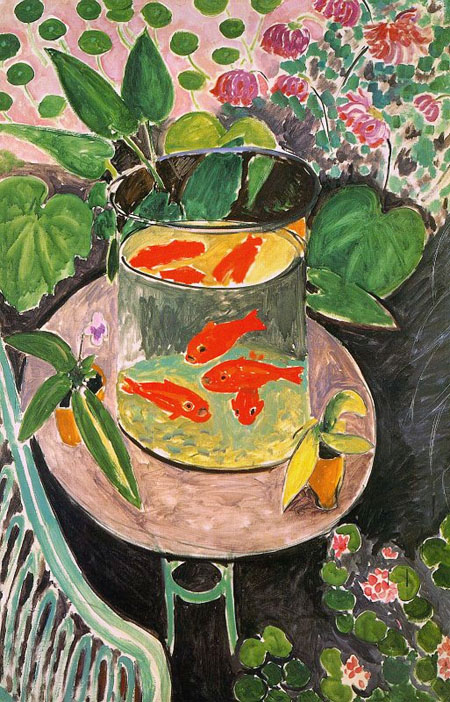
Matisse's "Gold Fish"

Van Gogh's "Shoes"

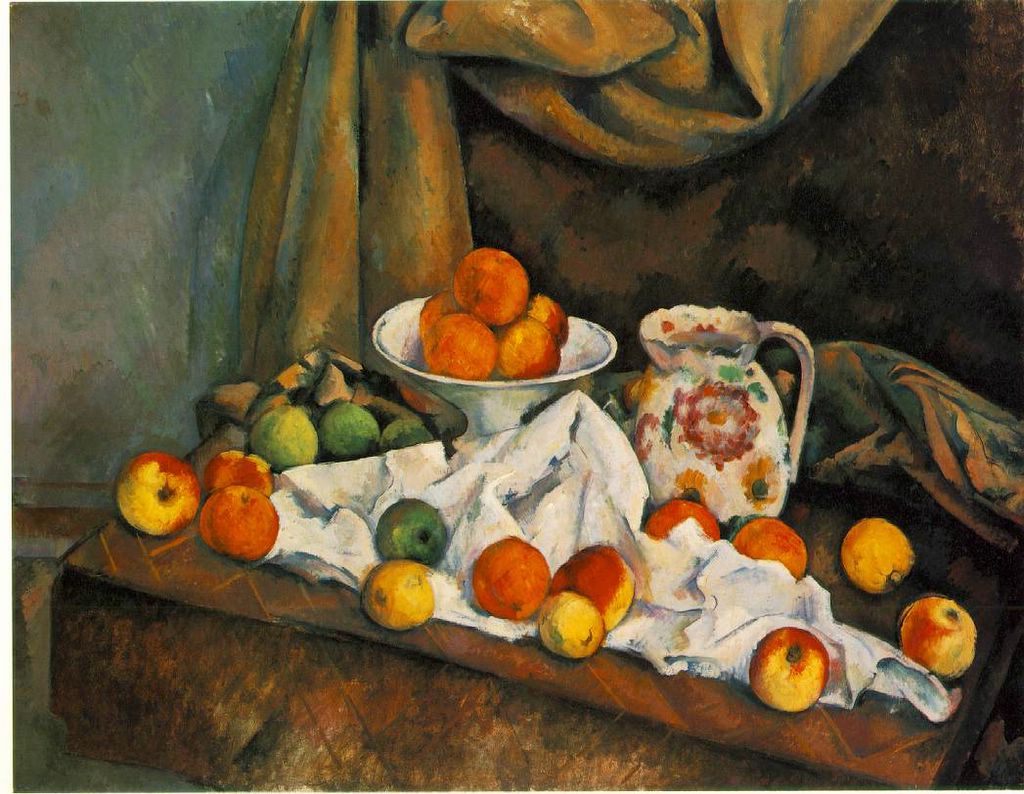
Cezanne's "Nature Mort"

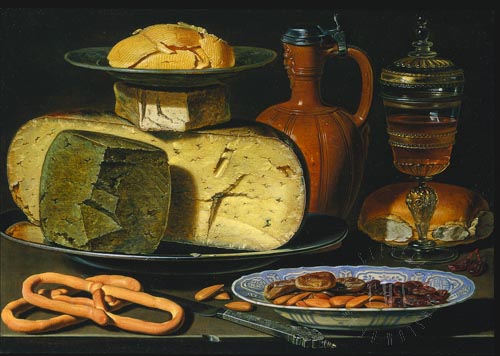
Clara Peters' "Still Life w Cheese"

Pieter Claesz's "Vanitas"

Still Life

Last class, I introduced this idea of reworking nature mort as a way to explore our personal environments. This is not faithful representation: it's more like recreation --even an idealization of what's most immediate and intimate. SL becomes different things for different people: a stage to make a point, to ponder something, even to persuade. So, for 17th-Century Dutch -great masters of the style- SL revealed a preoccupation with the epoch; whether a desire to make painting a participant in the scientific classification of insects, or to make art a moral arbiter (in the style known as vanitas). 17th-18th Century Spaniards used it to breach issues of class and tradition (as a didactic way to counter the appetite of the senses). 19th-Century Impressionists exploited SL as technical and formal: how to capture a fleeting moment as light reflects on different objects. For post-Impressionists SL offered a gamut of possibilities: Cezanne's apples work as a sort of Naturalistic manifesto, that is (in following Zola) how to reproduce "faithful perceptual reality." In Van Gogh's shoes we see a deep reflection on human existence (the shoes reveal what's not in the painting). During early 20th-Century, Picasso and Braque (at least during their Cubist phase) used nature mort as life’s most available and workable context. Juan Gris was also Cubist, but his still lifes are more the idealization of an imperfect reality. Finally, Morandi (perhaps the last Modern master of the genre) treats SL as his best account of an already shattered reality (life as andless recurrence through a movement of constant permutations).

Friday, September 23, 2005

Last night's presentation

Later I'll post something. In the meantime, what were your thoughts about Edwin Montalvo's presentation?

Wednesday, September 21, 2005

Update after "Rita"

Because of Rita, Maritza Molina had to cancel tomorrow. So, I'm trying to find somebody for the second half of our class. Saturday's post had a nice thread of comments. I'm glad you're participating. Remember it's part of the home work.
_________________________________________________________

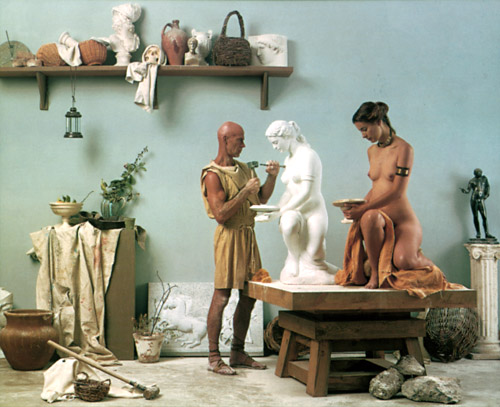
Painter Edwin Montalvo is coming tomorrow. He's an art teacher and shows with the Kevin Bruk Gallery. Montalvo makes these anachronistic part 17th-Century Dutch paintings (that look as digitalized 20th-Century illustrations). It should be interesting. Then, après la classe, there's an art auction nearby. I'll let you know tomorrow in case you want to come.

Saturday, September 17, 2005

The body

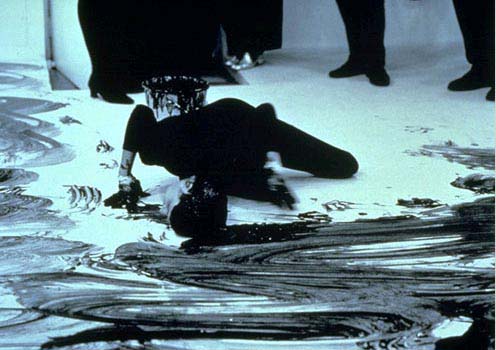
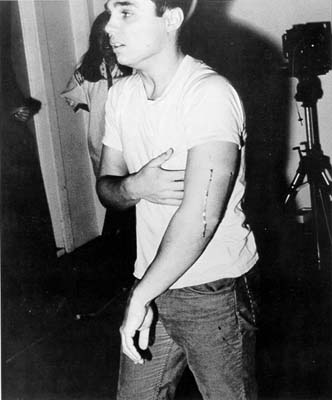
The late Sixties was a period of change in America (a civil-rights revolution took place while fighting a war of attrition in Viet-Nam thousands of miles away). Pop Art, Conceptualism, and Minimalism had taken New York by storm. In the midst of this commotion, a group of young artists found that they could use their bodies as vehicles to express themselves. They borrowed from Jackson Pollock's heroic gestures, feminism, neo-Dada happenings, and avant-garde theater (such as Antonin Artaud's theater of cruelty). Their aim was to bring the human body to the center of the political, social, and artistic debates. They turned into painting bodies, (like in the works of Yves Klein or Jackson Pollock), gesturing bodies (in the actions of Bruce Nauman, Joan Jonas and Eleanor Antin, or transgressive bodies, (as in the rituals of Ana Mendieta, Hermann Nitsch and Chris Burden).

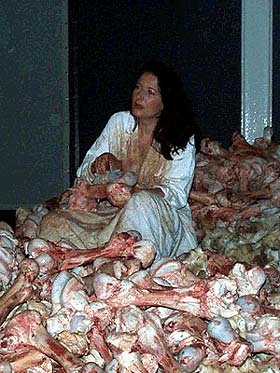
Marina Abramovic
_________________________________________
This piece, entitled Balkan Baroque won Abramovic a 1997 Venice Biennale Award. She spent four days cleaning 1,600 cattle bones while singing melodies from her mother country, Yugoslavia. Abramovic's performance happened during the war in Kosovo between Serbia and NATO.

Yves Klein

Eleanor Antin

Tracey Emin

Janine Antoni

Yayoi Kusama

Hermann Nistch

Bruce Nauman

Ana Mendieta

Friday, September 16, 2005

Bert

I thought that Bert's presentation (last night) was sincere, witty and funny. At the end, some of you brought up good points. Unfortunately we didn't have much time left. Let's take the time to share some opinions here. What did you think of his work? His presentation as a whole? Later with pictures. Please, leave your comments.

Wednesday, September 14, 2005

Update

I've sent stuff to all of you. It's possible you haven't received it. We'll deal with it on Thursday. Initially I assigned a one-page review of Carlos' show. That evening I only saw one student at the Moore Building (wait, I may understand your reasons). By sunday I'm receiving emails from some of you to the effect that you haven't been able to go. Ok. So, I send this handout (with this other HW consisting of a group of questions). My intention was not to overload you with homework, but only to keep the class on track with the issues at hand. In this class we talk, see, discuss and make art. I want to get out of the box a little, into galleries and museums. Miami is bursting with art from now until December. On Thursday let's make very clear what's what. Tonight I'm coming up with an interesting post. Good point Naomi, perhaps I need to be more clear with the overall assignment.

Monday, September 12, 2005

Hi, I sent an email with questions for my first handout. It's an exploration of art in the context of society, an analysis you don't often find in art schools. They treat art as something isolated, separated from the needs and practice of society. To start, I want to explore the idea of "high" and "low" in art, the so-called "genius" culture and how it happens, particularly in the West, since Modernity.

Saturday, September 10, 2005

There are a bunch of openings tonight, which you shouldn't miss (find all the addresses listed in the respective Websites) 1- In Wynwood I recommend this one at Ingalls and Associates, with openings by artists Pedro Velez, and Christian Duran. At Snitzer Gallery, an instalation by COOPER and photographer Maria Martinez-Canas. Next door to Snitzer is the new Kevin Bruk Gallery, with its first opening of the season. There's also Rene Barge's opening at the Dorsch Gallery. Also, over at Bernice Steinbaum Gallery, an opening by Flora Cohen. Finally, take a look at this, one of the best experimental spaces in Miami. Tonight, they have an opening of Eugenio Espinosa's Impenetrable. 2- If you happen to be in Miami Beach, check out Realidades Alteradas, a group show that seems pretty interesting with a bunch of Miami artists. ArtCenter/South Florida is located right on Lincoln Road, in the middle of everything. Actually, to make next week's home work easie, you can write a page (typed or wprocessed) about either these or Carlos Villasante's exhibit at the Buena Vista Building (180 NE 39 Street, Miami). I sent a group email already. If you haven't received it, that means you were not in my list. If so, please, resend your email.
Friday, September 9, 2005

Good morning. I made some changes in the "comment" template (am sorry I didn't see that before). You have three options: "blogger" (in case you have a blog), "other" and "anonymous." Check "post a comment" then "other," then write down your name and click "publish your comment." Or play with the choices, it's pretty easy now. There was plenty to see last night over at the Design District. I'll be back soon with comments about last night, assignments, etc. Have to go now.

Thursday, September 8, 2005

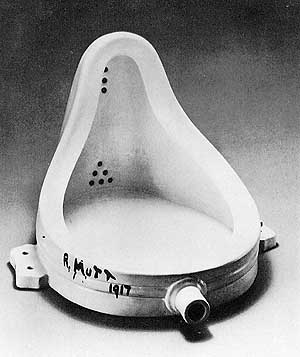
Since Duchamp, (Rose c'est la vie) a new paradigm was born. Art is anything you make (me-see within a certain mindframe). Duchamp put it inside the white cube, an art/microscope of sorts. As the biologist (or a curious child with a toy) we look inside it. The attitude is one of: curiosity, surprise, wonder, awe, or just indifference, or rejection (rejection is fine, it's a reaction to my own tastes). "This is bullshit, not art," but that will not make it non-art. It's art already. It has been for the past 90 years. The discussion is meaningless. Let's be pragmatic and move on, to a different more promising place. To the "I don't like it" or "I don't really care"-place. Rejection, indifference. Did I say before "a reaction" to my own tastes? One more question: Can tastes change?
________________________________________________
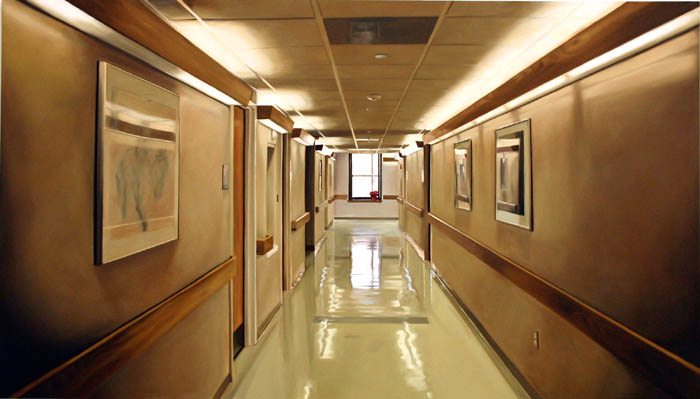
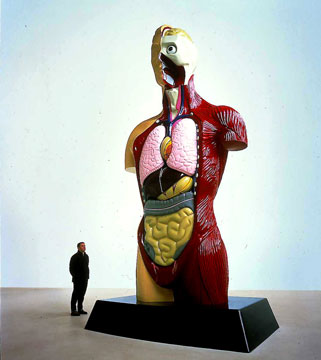
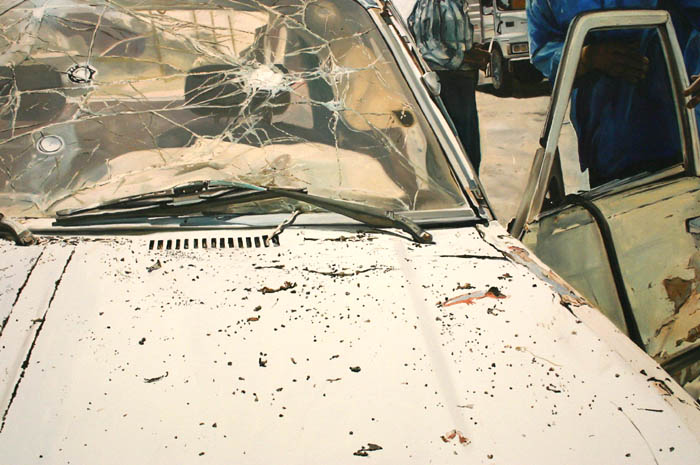
Below, some work by Duchamp, and his good disciple, Damien Hirst. You may hate Hirst, but he is a good disciple. See you tonight, and yes, after 106, let's go gallerying.

Last Supper

Hospital Corridor (Installation)

Painted Bronze

Car Crash

"Why not"

Glass

Fountain

Wednesday, September 7, 2005


"The Vanity of Allegory," is a show organized by conceptual artist Douglas Gordon at the Deutsche Guggenheim, located in the Deutsche Bank building on Unter der Linden. Billed as "a self-portrait in the guise of a group exhibition," the event brings together more than 30 works by artists who have previously shown at the museum, including Matthew Barney, Cerith Wyn Evans, Damien Hirst, Roni Horn, Jeff Koons, Robert Mapplethorpe and Lawrence Weiner. But if this is an exploration of the self-portrait, vanity and the search for immortality, Gordon becomes sort of a "man with a thousand faces" by highlighting relationships between apparent opposites. Here is Gordon’s own photographic portrait in masquerade as Kurt Cobain. He also mocked Andy Warhol, Myra Hindley and Marilyn Monroe (not shown).
___________________________________________________________
On a different note, I'll post some interesting links this weekend. Also updated the syllabus with confirmed visitors. Over...