Wednesday, November 7, 2007
An excerpt from a Guy Maddin's Tales from the Gimli Hospital (1988). Over the course of a career that has spanned nearly two decades and 25 films, both short and feature, filmmaker Guy Maddin has provided his viewers with more than their fair share of unique, cinematic moments. To provide just one example, in Tales, his first feature film, the audience is allowed to watch as one of the director's many eccentric characters, a male who is attempting to make himself more attractive to the ladies relaxing on a nearby beach, disappears behind a dilapidated building, troubled that his hair is dry and in such a mess. At this point, the audience may expect that some grooming is in order, but most first time viewers could never predict how such a grooming process will eventually unfold. Out of sight from the women, the character manages to find a shiny, dead fish, which he then squeezes frantically over his head, until its guts are wretched open, spilling fish oil all over the man's hair. The character soon reemerges, hair slicked back and full of fish oil. He is now ready to properly swoon the ladies still lying on the sands of Gimli beach (Senses of Cinema).
Excerpt from Japanese filmmaker Takashi Miike's 2003 film Gozu.
________
MS: You recently went to Cannes with "Gozu." Was the atmosphere different from the other festivals you've attended?
TM: "Gozu" was in the Directors' Fortnight section -- it's not the same as being in the competition. Within the larger festival I was able to find a time and place that suited my film -- a weekend evening screening. I also got a good reaction from the audience. They laughed and enjoyed it in a way that was very heartening.
MS: Before seeing "Gozu" I'd heard that, with its mixing of the horror and yakuza genres, it was another departure for you, but now that I've seen it, I feel that it's very much in line with your other work.
TM: That's right, "Gozu" is not a completely new type of film for me. But it was the first one in which I was involved from the planning stage. "Gozu" was originally supposed to be just another yakuza movie -- the producer came to me and asked me about making it that way. Ordinarily, once I say yes I try to make the film the way the producer wants, but in this case I didn't think the star he had in mind should be doing a yakuza movie. We wrote the script fairly quickly, but we didn't have much money, so we decided to set the film in Nagoya where we could save on costs. Then we shot the film -- it was the father's first film as a producer. That film was a big exercise in self-gratification. First the producer was making it for his son. Second, we were able to raise financing from new sources in Nagoya that gave us a freedom we might not have had otherwise. Third, we were able to go to Cannes and enjoy that experience together. In that way, it was different from my other films. The press materials talk about the film's resemblance to the work of David Lynch, but for me the biggest resemblance was to the manga of Yoshiharu Tsuge (excerpts from a Mark Schilling's interview with the filmmaker).
Brothers Quay's 1995 film Insitute Benjamenta , a bizarre odyssey, tightly composed and beautifully printed in black and white. The use of shifts in focus and depth, and the wild juxtapositions of the most mundane actions, creates a floating dream-like atmosphere, as if we are dumped into this world with no idea of what is going on, or what is going to happen.
Monday, November 5, 2007
Tuesday, October 30, 2007
Wednesday, October 24, 2007
Wednesday, October 10, 2007
Wednesday, October 3, 2007
Your turn #4
Tuesday, September 25, 2007
Monday, September 24, 2007

Wednesday, September 19, 2007
Tuesday, September 11, 2007
Your turn
Saturday, September 1, 2007
Your turn
Thursday, May 17, 2007
ART! BOOM! BUST!
Yet, under the surface, one can detect signs of discontent and frustration: Our real estate boom (now doomed and caused to some extent by Art Basel) drove up prices, changed the urban landscape and curbed our buying power. Believe it or not, life is harder now for many artists and alternative spaces. More people are realizing that between all the planning and executing, plus the post-Basel syndrome that ensues, the fairs drain the local scene’s energy from November to January. What’s left?
Paradoxically, because of the fair phenomena and the relative success they’ve enjoyed, artists have gotten comfortable and reclusive (waiting for their shows to happen all over again). What’s worse, many see themselves as sort of heroes who can operate —simultaneously — inside and outside the market environment.... (more here).
Thursday, May 10, 2007
Patrick Flibotte at Dorsch
Monday, May 7, 2007

Sunday, April 22, 2007
Job prospect
Tuesday, April 17, 2007
Is it art?


Formalism is a typically 20th Century development. It reacts against the idea of art as representation, as expression, or as a vehicle of truth or knowledge or moral betterment or social improvement. Formalists don’t deny that art is capable of doing these things, but they believe that the true purpose of art is subverted by its being made to do these things. "Art for art's sake, not art for life's sake" is the watchword of formalism. Art is there to be enjoyed for the perception and by means of its intricate and complex form. Formalism's right hand is aestheticism, which defends that the main function of art is to produce and elicit pleasure. It informs and instruct, represent and express, but first and foremost it must please.
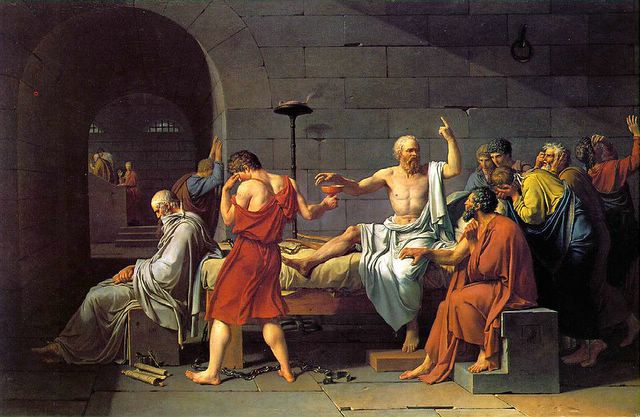
Many people believe that art as has a didactic function (to instill a positive influence, whether moral, social or political). Because art implants in people unconventional ideas; or breaks the molds of provincialism; or disturbs and disquiets (since it tends to emphasize individuality rather than conformity), art that does not promote a “positive” moral influence is received by the moralist with growing suspicion. For the moralist, art has the force to undermine beliefs and attitudes that are fundamental for his or her view of a good society.

The view of art as representation has been replaced by the idea of art as expression. The distinctive expressionist view of artistic creation is the product of the Romantic movement, according to which the creation of art is based on the expression of feelings. Instead of reflecting states of the external world, art is held to reflect the inner state of the artist. This, at least, seems to be implicit in the core meaning of "expression": the outer manifestation of an inner state.
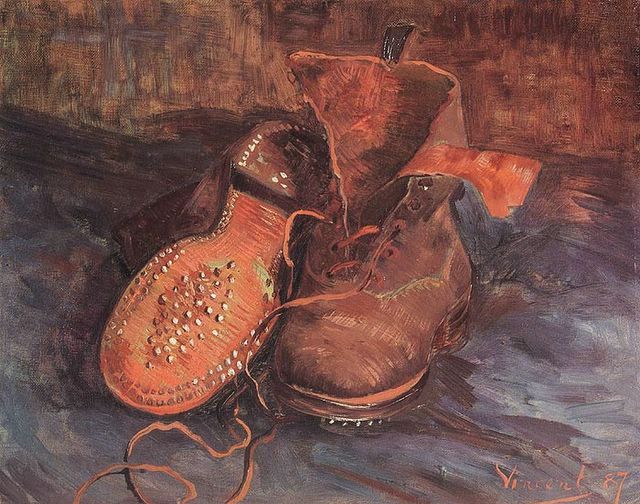
It's been said that art is a means to the acquisition of truth. Art has even been called the avenue to the highest knowledge available to man (and to a kind of knowledge impossible of attainment by any other means). Knowledge in the most usual sense of that word takes the form of a proposition, knowing that so-and-so is the case. Is knowledge acquired in this same sense from acquaintance with works of art? The question is whether there is anything that can be called truth or knowledge (presumably knowledge is of truths, or true propositions) that can be found in works of art.
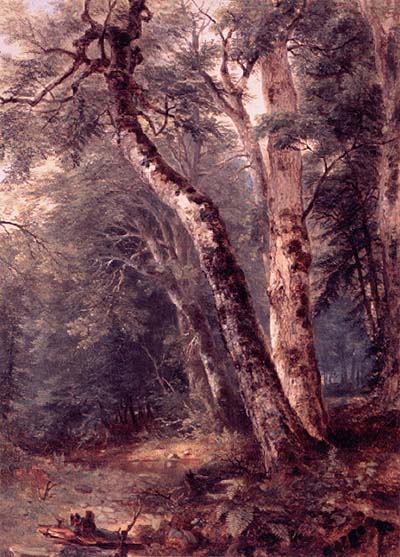
Art as imitation harks back to Plato. At some period in the history of art, people conceived art as if nature should be recorded by the artist with photographic fidelity. The invention of photography (which can do this better than any painter) could plausibly be said to have relieved the artist of any such responsibility.
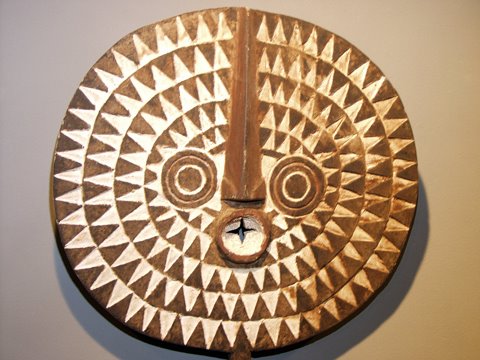
For some, art should be a repository for proverbial wisdom, ancient superstitions, sentimental themes, and religious beliefs. It should accompany and celebrates what is embedded in the lives of individuals and communities: baptisms, marriages, funerals, anniversaries, sowings, reapings, and the daily routine of work. Vernacular art becomes the soul of the people.
Monday, April 16, 2007
Final Paper: D'où venons nous? Que sommes nous? Où allons nous?
2-Three sections: Where am I coming from? Where am I? Where am I going?
3-Each section looks at a particular period in your artistic life:
a-“Where I’m coming from,” describes your background. When did art become important? What were your favorite pictorial themes (and why so)? Analyze your interests and concerns at the time. Any particular event that triggered an interest? Did you know all along?
b-“Where am I” looks at the present. Where are you with your art right now? Are you happy? Is there something that in youri opinion needs improvement? Visualize the dynamics of your style so far and comment what it means for you.
c-“Where am I going” projects yourself into the future: Use this section as a springboard to see yourself as becoming the best you can be. How do you see yourself in, say, five years from now?
4-Put all these elements in a narrative that flows. Please, don't entitle each section (the reading gets very boring); instead, suggest and imply the different stages into a consistent whole.
5- The paper should be in my mailbox at the Rainbow Building by Friday, April 27, at 2pm.
Thursday, April 12, 2007
The Art Market

Highest bid. “The sale in 1987, at auction by Sotheby's, of van Gogh’s Irises for $53.9 million was the highest ever price paid for a painting. It now turns out that half the price--$27 million--was loaned the “buyer” by Sotheby's which has retained possession of the painting for all but six months since the sale and has it now. The sale, if that is what it was, has the art world in an uproar. It raises the troubling question: Was this just a way to kite prices? The tab on old and new masters generally tends to rise when a benchmark purchase of this magnitude and notoriety is made; whatever Sotheby ultimately nets on “Irises,” the value of the remainder of its vast inventory is increased. As Alan E. Salz, Director of Didier Aaron gallery puts it, “Every painting sold since then has been measured against it...[and] ...maybe that wasn't a real price.” The art world is disturbed about more than the fact that this particular sale may have been manipulated: David Tunick, a New York dealer says “the art market has become so monetized...people have begun to think of art as a legitimate form of investment.” Richard L. Feigen, another art dealer notes “It's exactly like buying on margin ... by extending credit you are further inflating the prices, which are rapidly getting out of control.”-- Murray L. Bob; Monthly Review, Vol. 41, March 1990.

Art auctions. In an art auction, participants bid openly against one another, with each bid being higher than the previous bid. The auction ends when no participant is willing to bid further, or when a pre-determined "buy-out" price is reached, at which point the highest bidder pays the price. The seller may set a 'reserve' price and if the auction fails to have a bid equal to or higher than the reserve, the item remains unsold. "Art prices were relatively stable between the two world wars, but they began to rise in the 1950s. Prices for Pablo Picasso's works were thirtyseven times higher in 1969 than in 1951, and prices for Marc Chagall's works rose fiftyfold over that period (Myers, 1983). The increase in the price of art was especially dramatic after 1983, with prices peaking between 1987 and 1990 and then falling somewhat after 1990. Picasso's Yo Picasso sold at auction in 1989 for $47.9 million, twice the pre-auction estimate and eight times what it sold for in 1981. Jasper Johns' False Start sold in 1960 for $3,150; in 1988, it brought $17.5 million at auction. From 1975 until the late 1 980s, works by the following artists recorded these price increases: Jackson Pollock, 750 percent; Pierre-Auguste Renoir, 490 percent; Claude Monet, 440 percent; Edgar Degas, 350 percent; Camille Pissarro, 220 percent; and Alfred Sisley, 220 percent ( Duthy, 1988a, 1989b). Even works by more obscure painters have skyrocketed: from 1975 to 1988, prices for watercolors by English artist Thomas Girtin increased by 310 percent, prices for paintings by Swedish artist Bruno Liljefors rose by 340 percent, and prices for works by Scotland's J. D. Fergusson appreciated by 460 percent."-- Art Crime, by John E. Conklin; Praeger Publishers, 1994.

The art museum. An exhibition provides the objects and information necessary for learning to occur. Exhibitions fulfill, in part, the museum institutional mission by exposing collections to view, thus affirming the public’s trust in the institution as caretaker of the societal record. Museum exhibitions also accomplish several other goals. These include: Promoting community interest in the museum by offering alternative leisure activities where individuals or groups may find worthwhile experiences. Supporting the institution financially: exhibitions help the museum as a whole justify its existence and its expectation for continued support. Donors, both public and private, are more likely to give to a museum with an active and popular exhibition schedule. Providing proof of responsible handling of collections if a donor wishes to give objects. Properly presented exhibitions confirm public trust in the museum as a place for conservation and careful preservation. Potential donors of objects or collections will be much more inclined to place their treasures in institutions that will care for the objects properly, and will present those objects for public good in a thoughtful and informative manner.-- Museum Exhibition: Theory and Practice, David Dean; Routledge, 1996

Many contemporary art galleries specialize in avant-garde art, and others specialize in anything from old-masters to local artists to art-objects, crafts, etc. Contemporary art galleries are often found clustered together in urban centers such as the Chelsea district of New York or Wynwood, in the old warehouse district in Miami.
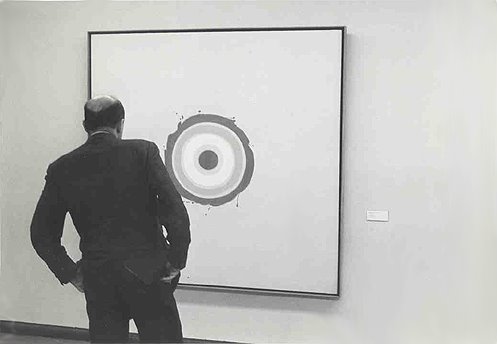
The art critic. The critic's job is not simply to evaluate what's good or bad. It would be too boring to constantly declare, "This is bad" or "This is good." [...] In addition to evaluations of good and bad, you may enjoy a critic's skillful description of an installation (what the experts call ekphrasis). Take it as a sort of movie preview, something writer Giorgio Vasari regularly did for his readers in Renaissance Florence. A writer may go "historic" like J.J. Winckelmann (the purported father of art history) and inscribe the artwork within a broad context that derives implications by analogy. Or the critic can emulate Denis Diderot's technique of moral embroideries -- the kind of thing Arthur Danto achieved in his essay on Mapplethorpe's photography. Another approach is to analyze the artist's desires and obsessions, as Thomas Mann did with Dürer's Melancholia in his novel Doctor Faustus. - Alfredo Triff, Miami Arts Explosion.