Thursday, February 8, 2007
Advertising
1- Though it's true that propaganda and advertising are both ways to sway public opinion, they are not the same thing. Because of the totalitarian justification of propaganda as a valuable tool to advance and legitimize the interests of the ruling party (Lenin, Goebbels, Plekhanov, etc), the term has strong political overtones. On the other hand, advertising uses techniques and practices to bring products, services, opinions, even causes to public notice for the purpose of persuading the public to respond in certain ways. In a Capitalist system, most advertising involves promoting “goods for sale,” but similar methods are used to encourage people to drive safely, to support various charities, or to vote for political candidates, among many other examples. 2- Advertising is late-Capitalism’s most important source of income for the media (e.g., newspapers, magazines, or television stations). 3- The most basic media for advertising are: (a) Newspapers (offers large circulations, a readership located close to the advertiser's place of business, and the opportunity to alter content on a frequent and regular basis), (b) Magazines (of general interest, aimed at specific audiences), (c) TV and radio. For advertisers the most important facts about a TV or radio program are the size and composition of its audience (size determines the amount of money the broadcaster can charge; composition determines the advertiser's choice as to when a certain message should be run). (d) Other minor media are direct mail, outdoor billboards, posters, transit advertising (which can reach the millions of users of mass-transit systems) and even smaller items, such as matchbooks or calendars. 4- Advertising will be effective if its production -and placement- is based on a knowledge of its target, plus a skilled use of the media. Advertising agencies can orchestrate complex campaigns (whose strategies are based on research into consumer behavior and demographic analysis). So, the marketing side of advertising employs publicity to achieve its aim. 5- There’s no question that advertising is a powerful way to inform consumers. In a free-market economy effective advertising is essential to a company’s survival, for unless consumers know about a company's product they are unlikely to buy it. In criticism of advertising it has been argued that the consumer must pay for the cost of advertising in the form of higher prices for goods; against this point it is argued that advertising enables goods to be mass marketed, thereby bringing prices down. 6- It has been argued that the cost of major advertising campaigns is so high that it stimulates oligopolies. 7- Finally, there’s the issue of “undue influence,” false advertising and the use of deceptive techniques such as concealment of facts, exaggeration and other psychological appeals.
“Today marketers continue to use more sex in advertising for a greater range of products. For example, a recent ad in Linux Journal for computer hardware products featured the face of an attractive woman and this headline: “Don't feel bad, our servers won't go down on you either. ” Although one could say that the ad is sexist, it represents a use of sexual imagery and double entendre used to sell a brand not traditionally linked to sex. At the same time, brands traditionally associated with sex appeals —designer clothing and accessories, alcohol, and “better sex” videos— appear to be featuring sexual imagery that is increasingly explicit.”—Sex in Advertising, Jacqueline Lambiase & Tom Reichert (Earlbaum Associates, 2003).
Did you know about the Buy Nothing Day or TV Turn Off Week? What do you think about these anti-commercial techniques?
A Marlboro Ad from the 1960’s. It identifies the brand with a particular place: “Marlboro Country.” The epic music and the slow gallop of the horses amalgamate with the cool and tough profile of the cowboy smoking a cigarette.
This Adbusters commercial is straightforward and true (though I wonder if people would stop eating burgers at McDonald after they see it).
Stylistically speaking, René Rodriguez and Frank Miller's Sin City works so well because it remains faithful to the visual style of noir (fast paced, violent, gritty and stereotypical), while treating it as a parody. See how self-conscious the art of poster has become, after the style of photo realism took over Hollywood: Walk into a Blockbuster store and just glance over hundreds of titles. They all look the same.

Otto Preminger's Laura (1944). This is a typical poster for a film noir of the epoch. The idea is to display the "stars" while suggesting the film’s plot (not an easy task). In order to keep a compositional balance, the designer would present the figures in different sizes (depending that character's function in the movie) along with the lettering. The message was as important as the images. The man in charge for the art direction was Leland Fuller, who won Best Interior Design for Laura.
Without Saul Bass (1920-1966) Otto Premiger's The Man With the Golden Arm (1956) would not have the same visual appeal. Bass created a style for movie credits. His design for this famous sequence borrows from Bauhaus and a bit of Constructivism (the music score is by Elmer Bernstein). Bass went on to work with Hollywood luminaries such as Hitchcock (in "Vertigo" and "Psycho"), Robert Aldrich ("The Big Knife"), Kubrick ("The Shining") and Scorsese ("GoodFellas"). Bass was born in the Bronx, and studied with Gyorgy Kepes, a hungarian designer and disciple of Moholy-Nagy.
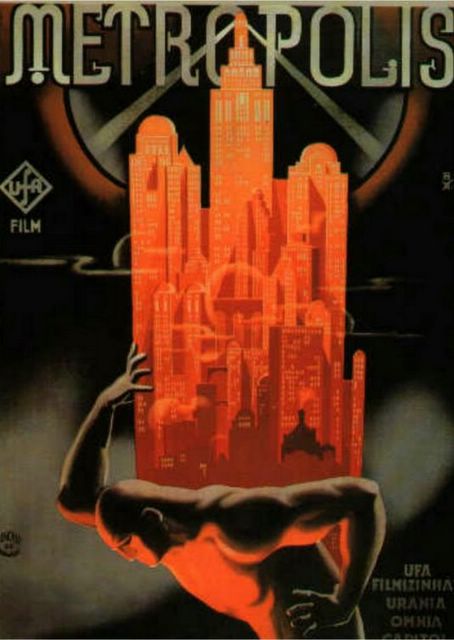
Fritz Lang's Metropolis (1927). Though Lang’s masterpiece has an Expressionist feeling, the design for the poster uses a modern nouveau style. It is said that with Metropolis, Lang wanted to make a "futurist film."
The ad suggests a link between fashion and Nissan’s new car, the Micra. A busy young female (a Japanese designer?) moves around in a stylish little car (giving the final touches to mannequins in a shop window). At the end of the clip we read: “Cities are made for Micra,” along with a view of the Eiffel Tower (a symbol of cosmopolitanism).
A Spielberg-like theme (to the music of John Williams): The ibook not only empowers the girl to move things from a distance inside her room, but to finish her chores right on time. The ad has a definite family appeal (who buys the ibook?).
Thursday, February 1, 2007
A brief analysis of propaganda
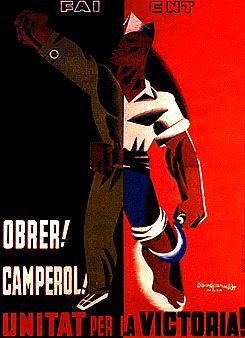
1- The term propaganda comes from the title and work of the Congregatio de Propaganda Fide (Congregation for Propagation of the Faith), an organization of Roman Catholic cardinals founded in 1622 to carry on missionary work. 2- Propaganda also means agitation. Elaborating upon Lenin's pamphlet What Is To Be Done? Russian Marxist Georgy Plekhanov defined propaganda as “the reasoned use of historical and scientific arguments to indoctrinate the educated and enlightened.” He defined agitation as the use of "slogans, parables, and half-truths to exploit the grievances of the uneducated and the unreasonable." He regarded both strategies as absolutely essential to political victory and twinned them in the term agitprop. 3- This is how Joseph Goebbels (Hitler's minister of Propaganda) understood it: "Political propaganda in principle is active and revolutionary. It is aimed at the broad masses. It speaks the language of the people because it wants to be understood by the people. Its task is the highest creative art of putting sometimes complicated events and facts in a way simple enough to be understood by the man on the street. Its foundation is that there is nothing the people cannot understand, but rather things must be put in a way that they can understand. It is a question of making it clear to him by using the proper approach, evidence, and language." 4- Propaganda manipulates other people's beliefs, attitudes, or actions by means of symbols: Words, gestures, banners, monuments, music, clothing, insignia, hairstyles, designs on coins and postage stamps, and so forth. 5- At the level of symbols: Gestures (a military salute); postures (a weary slump, folded arms, a sit-down, an aristocratic bearing); structures (a monument, a building); items of clothing (a uniform, a civilian suit); visual signs (a poster, a flag, a picket sign, a badge, a printed page, a commemorative postage stamp, a swastika scrawled on a wall); all these constitute instances of propaganda. 6- Contemporary propaganda employs elaborate social-scientific research facilities to conduct opinion surveys and psychological interviews in efforts to learn the symbolic meanings of given signs. Written media include letters, handbills, posters, billboards, newspapers, magazines, books, and handwriting on walls and streets. Among audiovisual media, TV is the most powerful. 7- Although propaganda and advertising share a number of strategies, I prefer not to overlap them. Advertising includes all forms of paid, nonpersonal communication and promotion of products, services, or ideas by a specified sponsor. It appears in print media (newspapers, magazines, billboards, flyers) or broadcast (radio, TV). We'll tackle the issue later on in the semester.

El Guerrillero Heroico (Cuba, 1969). The image of El Che (the Argentinian guerilla fighter who died in the jungles of Bolivia) is one of the most important icons of late Twentieth Century propaganda.

The Islamic Revolution (early 1980's). A typical gesture of the Iranian poster after the revolution, the clenched fist rises up directly out of the people.

Stalingrad! (1943) The poster illustrates the defeat of the Germans at the Battle of Stalingrad, a turning point in the German war in the easter front.
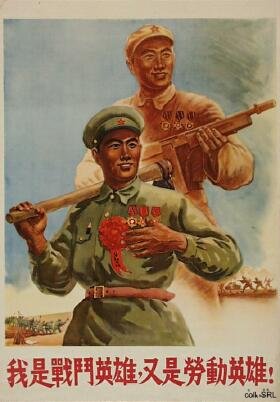
Chinese posters served to inform of Land Reform policies and to publicize new rules and regulations, such as the Marriage Law; rectification movements of intellectuals; campaigns to weed out corruption, bureaucratism and petty crime; and movements to boost popular support for the new regime, in particular in the cities. All the people were mobilized to help reconstruct the country in whatever manner possible (see how important the color red is).
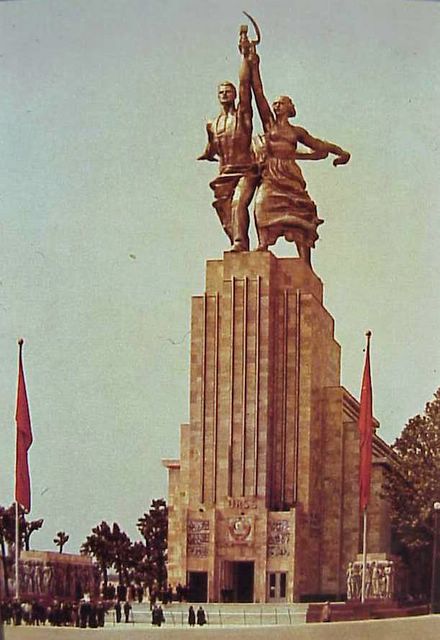
Soviet pavillion (Paris Expo, 1937) Boris Iofan, architect. Of course, Iofan is no Speer. The similarity between the two monuments has to do with how Neo-Classicism becomes a style that can easily define totalitarian regimes. Stalin's love for Neo-Classical architecture (see this link) harks back to (irony of ironies!) a New York building designed by McKim, Mead & White.
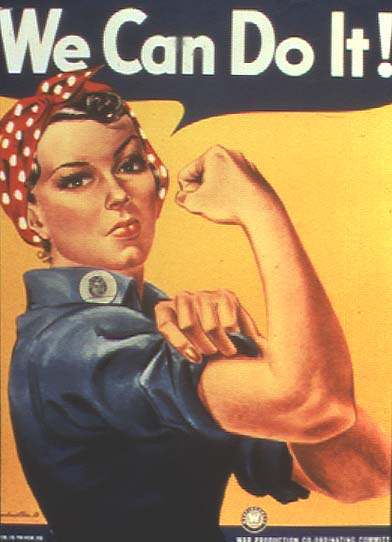
We Can Do It. An American poster by J. Howard Miller (circa 1944). From 1941-45, women were asked to join forces for the war effort. They proved to be as efficient as men at working in the factories. This poster hints at equality: A young woman wearing a factory uniform, rolls up her sleeves while flexing her biceps -a typical male gesture of vigor.
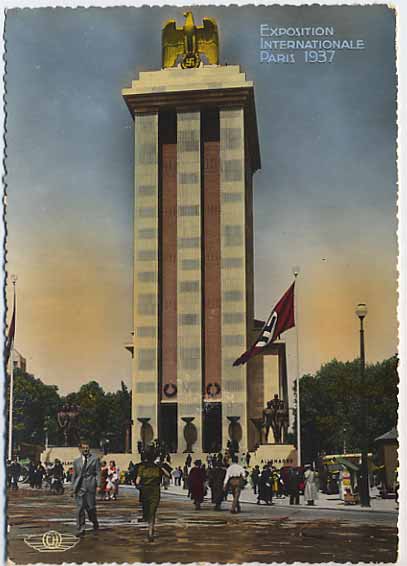
German Pavillion (Paris Expo, 1937). Albert Speer, architect. Even in spite of its short reign (1933-1945) was there a Nazi architecture?
This clip is taken from Leni Riefenstahl's famous propaganda movie "Triumph des Willens" (1935). French writer Georges Bataille wrote about the "aesthetic power" of these highly manipulated Nazi public demonstrations, which appeared as sacred symbols (one can tell the amount of detailed planning of choreography and mis-en-scene behind them). Hitler would say: "The receptive powers of the masses are very limited, and their understanding is feeble. All effective propaganda must be confined to a few bare essentials and these must be expressed as far as possible in stereotyped formulas. These slogans should be persistently repeated until the very last individual has come to grasp the idea that has been put forward…" (Doesn't it sound a bit like modern advertisement?). Trumph of the Will is widely regarded as one of the most effective pieces of propaganda ever produced. A masterful, epic, innovative work of documentary filmmaking, commissioned by the Nazi party and widely used to support Hitler's cause before the war. The film was a rousing success in Europe, but widely banned in America.
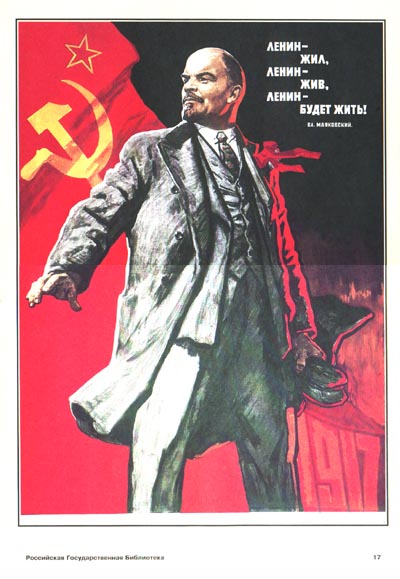
Lenin was, Lenin is, Lenin will live! (Soviet poster, 1940's). Lenin is the father of the Bolshevik Revolution. This poster uses his image to legitimize the Soviet offensive against the Germans under the Stalin regime.
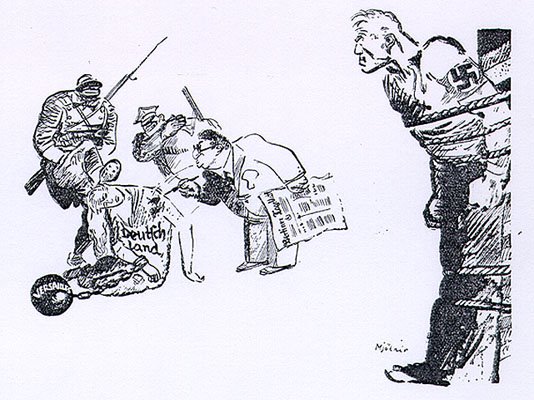
Nazi propaganda before 1933. A tied-up Nazi watches while a Jew reading the Berliner Tageblatt, which the Nazis accused of being a Jewish paper, mistreats a Germany chained to the Treaty of Versailles. The Jew is probably supposed to be a journalist, since he is smearing Gemany with his pen. A Black French colonial soldier and another figure (either a policeman or a Polish soldier) assist.
An early form of propaganda
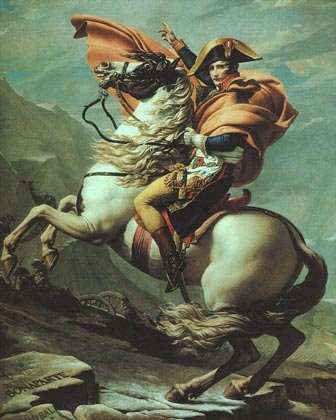 Napoleon Crossing the Alps (by Jacques-Louis David). This epic painting is a form of early propaganda. With it, David idealized and legitimized Napoleon's Italian Campaign of 1796. After Napoleon's fall, David's work lost its social and political influence.
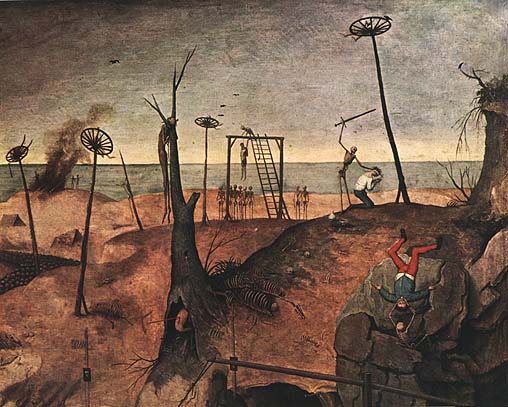
Peter Brueghel's Triumph of Death. According to 15th Century Treatise Ars Memorandi, "If you want to educate with images, choose the most frightful ones."
Thursday, January 25, 2007

Symbols in art
1- Clouds mean rain, a falling barometer means that a storm is coming, a twister in the sky means an approaching tornado: one is a sign of the other. These relations exist in nature and were discovered, not invented by humans. On the other hand, a bell ringing means the end of class, the word “cat” means a certain species of domesticated quadruped. These relations are conventional. 2- In art, what is it that makes a thing a symbol? It is something represented in the artwork (an object, an action, or a pattern of objects and actions, or just a color) that does the symbolizing? How does A become a symbol of B? 3- The cross is a symbol of Christianity (a conventional token of suffering) but this is a historic and religious convention. Though used as the main symbol of nazism, the swastika is considered sacred in Hinduism, Buddhism and Jainism. Who owns the symbol? The sun seems like a natural symbol of life and strength; a river brings forth the idea of eternal change and flowing, and so forth. In these cases there was no agreement (convention) as to what would stand for what; the relation is too obvious. 4- According to philosopher Nelson Goodman one can virtually make any A to stand for any B, provided one can justify the link -an important premise for an artist. 5- Here are some examples of how virtually anything can be a symbol for something else: animals, parts of the body, abstract characters, artefacts, plants, etc. A circle → the cosmos (in Shamanism); a triangle→ perfection; an ant→ industry; the ape → loyalty and devotion (ancient India); the arch→ the union of earth and sky (ancient Greece); the human beard→ wisdom, strength and virility (Semitic religions); blood→ a tantric image of fertilization (Vedas); ying/yang→ positive, negative (Ancient China); A and ω→ beginning and end (ancient Greece); the dog→ watchful guardian (ancient Egypt); Moby Dick→evil. 6- So, to further problematize the issue: What would Duchamp's Fountain stand for?
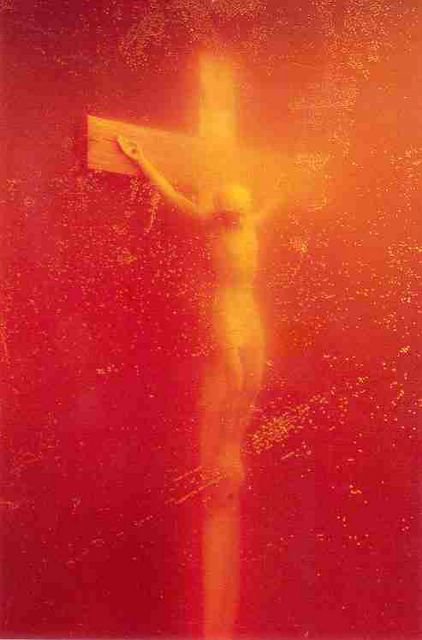
For some Andres Serrano's "Piss Christ" has become the opposite of the original image. But would it matter if you didn't know the controversy?

The skull depicted in this painting by Dürer may count as more "natural" than "conventional" because of the obvious reference that the symbol has with mortality.

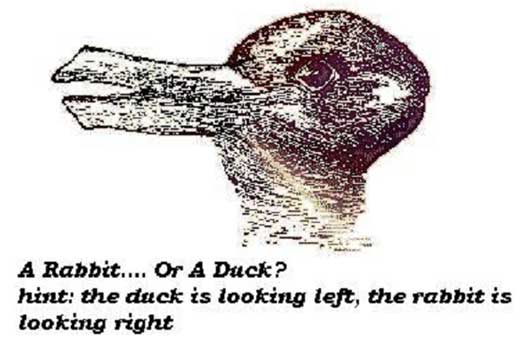
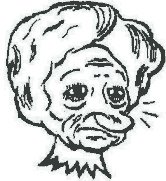
Both these images are pretty vague. On the left, the superimposition of two faces (a young woman over an old lady). On the right, Wittgenstein's famous Duck/Rabbit. Both point to so called psychological illusions.
Subscribe to:
Posts (Atom)